
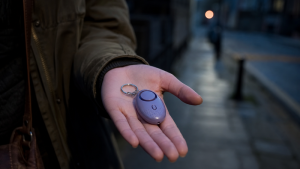
U.S. Legal in Most States • Discreet Shipping • Real-World Protection • No Permits Required in Most Areas
U.S. Legal in Most States • Discreet Shipping • Real-World Protection • No Permits Required in Most Areas

A reliable keychain stun gun delivers consistent voltage, activates without hesitation, fits securely in your hand, stays charged between uses, and physically cannot fire accidentally. Those five qualities — output consistency, activation reliability, ergonomic grip, battery longevity, and a built-in safety mechanism — are the difference between a device that protects you and one that lets you down at the worst possible moment.
Here’s what nobody tells you when you’re standing in a checkout aisle or scrolling through product pages at midnight: most people who carry a stun gun never think about whether it will actually work until the moment they need it to. And that moment, if it comes, gives you no time to wish you’d looked more carefully. This post is about looking carefully now — so that if you ever reach for that device on your keys, it does exactly what you need it to do.
Every stun gun package has a number printed on it. Millions of volts. Sometimes tens of millions. It’s the first thing your eye goes to, and it’s also one of the most commonly misleading metrics in the entire self-defense market. What matters far more than peak voltage is whether that output is consistent — whether the device delivers the same stopping power on the first activation as it does on the tenth, or the twentieth.
A quality keychain stun gun maintains its output across repeated activations without significant drop-off. Cheap units often spike on the first trigger press and degrade quickly from there. If you’ve had to press the trigger multiple times in a real confrontation, you need that second and third activation to carry the same weight as the first. Brands like Streetwise and Runt are built around consistent output performance at compact form factors — because the people who carry them understood exactly this problem.
When you’re evaluating a keychain stun gun, look for independent performance data rather than marketing copy. Our post on how to spot a quality stun gun walks through the red flags that signal weak construction — including suspiciously high voltage claims with no supporting specifications.
Think about what a self-defense situation actually looks like. You are not standing at a range with time to prepare. You are likely startled, moving, adrenaline spiking, hands possibly trembling. Your keychain stun gun needs to go from clipped to your bag to active in your hand in under two seconds — and it needs to fire the moment you press that trigger. Not after a delay. Not after a second press. Immediately.
This is where cheap keychain stun guns fail in the most heartbreaking way. Stiff activation buttons, mechanical lag, or overly complicated safety disengagement sequences cost you seconds you don’t have. A device with a smooth, deliberate trigger that disengages safely but deploys instantly is the standard to hold every option against.
Consider also whether the device activates from a natural grip. If you have to think about which direction to press, or adjust your fingers to reach the button, that’s cognitive load you cannot afford under stress. The best keychain stun guns are designed so that the correct grip and the correct activation motion are the same motion — intuitive, direct, instant.
Size is not the same as grip. A keychain stun gun can be compact and still fit poorly in your hand — and when your hands are cold, wet, or shaking, a poor grip becomes a liability. The contours of the device, the texture of the surface, the weight distribution — all of it matters more than most buyers realize until they’re trying to hold the thing firmly while everything else is going wrong.
A stun gun with a wrist strap addresses one of the most serious grip concerns directly: even if your grip breaks, the device stays with you. That single feature can mean the difference between deploying your tool and watching it hit the ground. Look for textured surfaces — rubberized or contoured casing that doesn’t require a perfect grip to stay controlled.
The Runt stun gun, for example, is designed specifically around the compact-but-grippable problem. Its form factor accounts for realistic hand positioning under stress. That kind of intentional design is what you’re looking for — not the slimmest profile or the most aggressive-looking casing, but the one that you can actually hold when it counts.
Here’s the truth that never gets enough attention: a stun gun that runs out of charge before you need it is just a piece of plastic. Keychain devices live at the bottom of bags, clipped to backpacks, cycled in and out of jacket pockets. They do not get the kind of regular attention that a phone does. Which means the battery performance when you haven’t thought about it in three weeks matters enormously.
A rechargeable stun gun with a lithium battery holds charge significantly longer than disposable-battery models and gives you a visual indicator — often an LED — so you know the status at a glance. The ritual of plugging in your stun gun whenever you charge your phone is a habit that takes five seconds and can make a profound difference.
High-drain events also matter. Some keychain stun guns show adequate charge until you actually fire them — and then drain rapidly under real use. A quality device maintains functional output across multiple activations before charge drops significantly. When you’re reviewing specs, look for real-world activation counts per charge, not just standby time.
Accidental discharge is not a minor inconvenience. Discharging a stun gun against your own leg in a crowded room, or inside your bag against your hand, is a painful, disorienting event that can put you at greater risk than carrying nothing at all. A well-designed safety mechanism is not an obstacle to fast deployment — it is an integral part of responsible carry.
The most effective safety systems on keychain stun guns are those that require deliberate engagement to disable — a slide, a twist, or a dedicated safety switch — but that disengage smoothly and naturally as part of the grip and draw motion. What you do not want is a safety that requires two hands, fine motor dexterity, or visual confirmation to disengage. Under stress, you will not have any of those things reliably available.
Some of the best models integrate a disable pin or wrist strap lanyard that completes the safety circuit when worn and breaks it if the device is grabbed away. That layer of engineering is the kind of design choice that tells you the manufacturer was thinking about real use, not just aesthetics. If you’re considering a stun gun for a higher-risk environment — bartending late shifts, working campus security — our guide on stun guns for bartenders covers specific features that matter in public-facing roles.
None of these five features exist in isolation. A stun gun with a great safety but inconsistent output is still a liability. A perfectly ergonomic device with a dead battery is useless. Reliable keychain protection is a system — every component has to hold up simultaneously, under the same circumstances, at the same moment.
This is why the buying decision deserves more care than most people give it. The keychain stun gun you carry is making a silent promise every single day: that it will work when you need it. The only way to know that promise is being kept is to understand what makes it possible — and to choose accordingly.
If you’re looking for the right place to start, browse our full stun gun collection and filter by the features that matter most to your daily carry. Whether you’re a student, a professional, or someone who just wants to feel safer walking to your car at night, there is a device built for exactly your situation.
Voltage numbers printed on packaging are often inflated and inconsistently measured across manufacturers. What matters more is amperage — typically 3–4 milliamps is considered effective for stopping a threat — and consistent output across multiple activations. Focus on reputable brands with transparent specifications rather than raw voltage claims alone.
Stun gun laws vary significantly by state, county, and city. Most U.S. states permit legal carry for adults, but some jurisdictions restrict carry in specific locations or require permits. Always verify your local regulations before purchasing. Nothing in this post constitutes legal advice — check your state and local statutes directly.
For rechargeable models, charging once per month maintains optimal readiness if you haven’t used the device. A practical habit is plugging it in whenever you charge your phone — this ensures it’s always near full capacity. Avoid leaving the device fully discharged for extended periods, as this degrades lithium battery longevity over time.
A quality keychain stun gun with a properly functioning safety switch should not discharge accidentally. However, low-quality devices with worn or improperly designed safety mechanisms can fail. Always verify your safety is engaged before placing the device in a bag, and choose models with a slide or wrist-strap safety system that physically prevents activation without deliberate disengagement.
Most rechargeable models include an LED charge indicator. To test function, engage the safety and briefly press the activation button in the air — a visible arc and audible crack confirm the device is producing output. Do not hold the trigger for more than one second during testing. Perform this check monthly or any time you’ve had the device for an extended period without use.
Yes — keychain stun guns are among the most practical self-defense options for college environments because they integrate into everyday carry without requiring a separate holster or bag. Compact models with wrist straps are particularly suited for walking between classes or across campus at night. Review specific options designed for this use case in our college campus stun gun guide.
Keychain stun guns are optimized for portability and constant carry — they attach directly to your keys so they’re accessible any time your keys are in your hand. Full-size models typically deliver higher output and longer electrode spacing but require deliberate carrying. For most everyday situations, a quality keychain model offers sufficient stopping power with significantly better accessibility.
Both tools have distinct tactical profiles. Pepper spray works at range — typically up to 10–12 feet — without requiring contact. A stun gun requires direct contact but is unaffected by wind and doesn’t risk affecting bystanders. Many people carry both. For a detailed comparison of how these two options perform in real scenarios, read our post on pepper spray vs. stun gun.



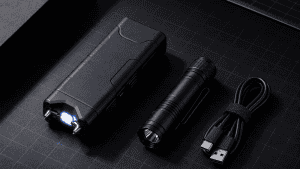




We use cookies to improve your experience on our site. By using our site, you consent to cookies.
Manage your cookie preferences below:
Essential cookies enable basic functions and are necessary for the proper function of the website.
These cookies are needed for adding comments on this website.
Statistics cookies collect information anonymously. This information helps us understand how visitors use our website.
Google Analytics is a powerful tool that tracks and analyzes website traffic for informed marketing decisions.
Service URL: business.safety.google (opens in a new window)
