

U.S. Legal in Most States • Discreet Shipping • Real-World Protection • No Permits Required in Most Areas
U.S. Legal in Most States • Discreet Shipping • Real-World Protection • No Permits Required in Most Areas
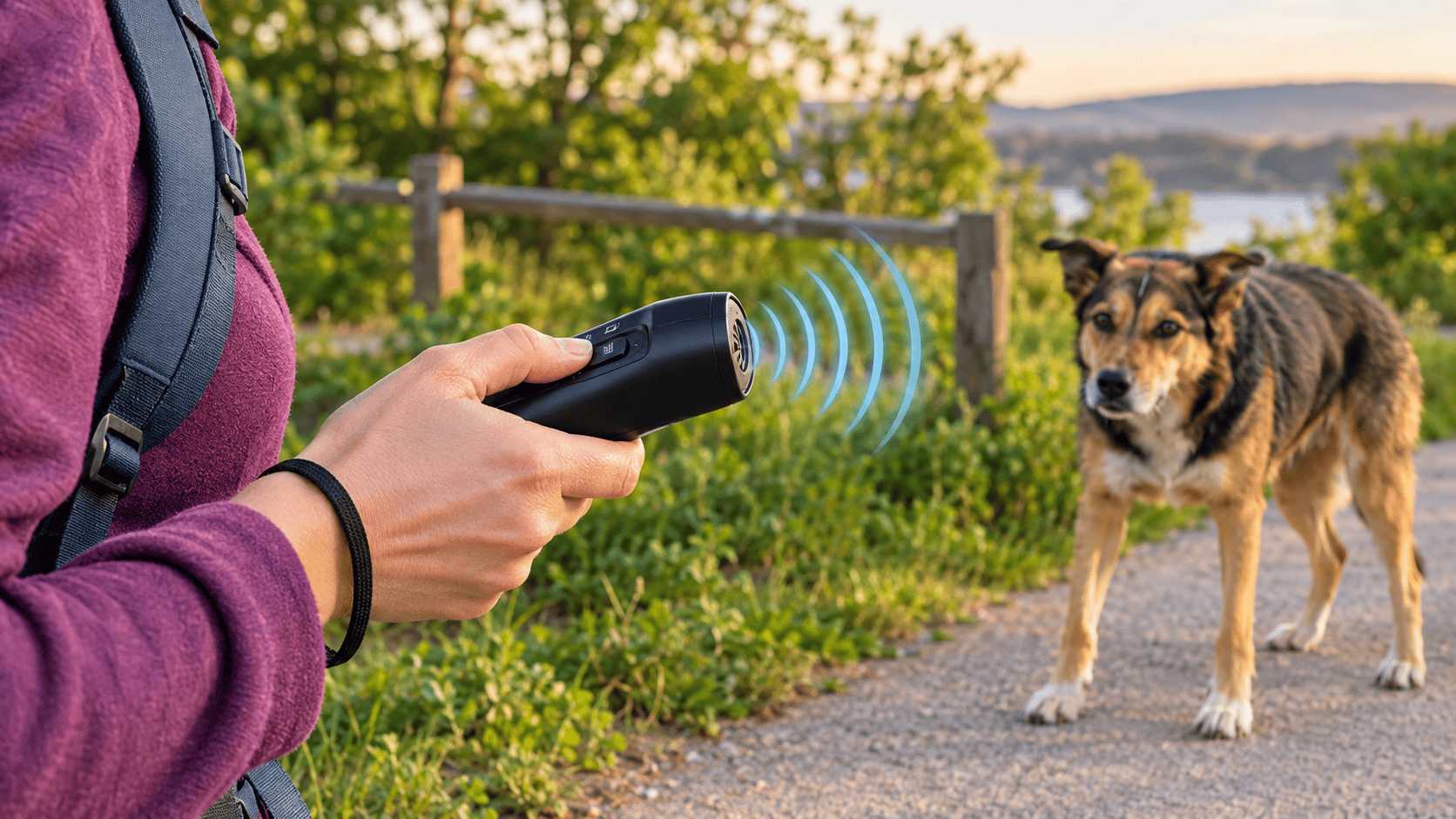
Do Ultrasonic Dog Repellents Really Work? Ultrasonic dog repellents are often advertised as a convenient, contact-free way to discourage unwanted approaches from unfamiliar dogs. For walkers, joggers, delivery workers, and pet owners, the idea is appealing: a small handheld device that produces a high-frequency sound without requiring physical contact with an animal.
But do ultrasonic dog repellents really work? The answer is more complicated than a simple yes or no. Some dogs respond to ultrasonic sounds, while others show little noticeable reaction. Understanding how these devices work, what research has found, and where their limitations lie can help you make an informed decision.
An ultrasonic dog repellent is an electronic device designed to produce sound at frequencies above the usual range of human hearing. Many dogs can hear higher-frequency sounds than humans, making these signals potentially noticeable to them even when people hear little or nothing.
Portable ultrasonic devices are commonly marketed for situations involving unfamiliar dogs, unwanted barking, or behavioral training. Some are handheld and battery-powered, while others are designed for stationary use around homes or outdoor spaces.
Although these products share similar technology, their intended applications and performance characteristics can differ considerably.
Ultrasonic repellents use electronic components to generate high-frequency sound waves. Depending on the device, the sound may be emitted continuously or in short bursts.
The intended effect is to attract a dog’s attention, interrupt its current behavior, or encourage it to move away from the sound source. However, hearing a sound and responding to it in a particular way are two different things.
A dog might pause, turn its head, retreat, become curious, or show no obvious reaction. Responses can vary according to the animal’s hearing, previous experiences, emotional state, and surroundings.
Environmental factors also matter. Distance, background noise, obstacles, and the orientation of the device can influence how sound reaches an animal.
Research suggests that ultrasonic devices can influence canine behavior under certain conditions, but the evidence does not establish that they reliably repel every dog.
A study published in Applied Animal Behaviour Science examined dogs’ responses to ultrasonic, audible-sound, and flashing-light devices. The researchers observed reactions to some devices, but no device repelled every dog tested.
You can review the research in Aversive Responses of Dogs to Ultrasonic, Sonic and Flashing Light Units.
Another study examining ultrasonic devices and guide dogs found that some animals noticed the sounds without displaying substantial behavioral disruption. That illustrates an important distinction: detecting ultrasound does not necessarily mean an animal will retreat.
See Effect of Ultrasonic Devices on the Distraction Behaviour of Guide Dogs.
More recent preliminary research has also reported behavioral responses to ultrasonic signals in some free-roaming dogs. However, the authors acknowledged that additional research is necessary to establish effectiveness under different conditions.
Read Design and Implementation of an Arduino-Based Ultrasonic Device for Humane Dog Repellent.
The practical takeaway: Ultrasonic technology may affect some dogs, but it should not be treated as a guaranteed method of stopping an approaching animal.
Several factors may help explain why ultrasonic devices produce inconsistent results.
Dogs do not all have identical hearing abilities. Age, hearing health, and individual sensitivity may influence whether an animal notices a particular frequency.
A relaxed dog exploring its surroundings may respond differently from an animal that is frightened, highly excited, or focused on another stimulus.
Sound intensity generally decreases with distance. Buildings, vegetation, competing sounds, and other environmental conditions may also affect the signal reaching the dog.
Some animals may become less responsive to repeated sounds, particularly when those sounds have no meaningful consequence. Responses should never be assumed to remain consistent over time.
Because ultrasonic repellents do not require physical contact or chemical sprays, they are sometimes described as humane alternatives. However, contact-free does not automatically mean stress-free.
High-frequency sounds can be unpleasant or startling to some animals. The effect depends on the sound’s characteristics, intensity, duration, and the individual dog.
Responsible use means following the manufacturer’s directions, avoiding unnecessary or prolonged exposure, and paying attention to signs of distress.
It is also important to distinguish an occasional deterrent application from routine behavioral training.
The American Veterinary Society of Animal Behavior recommends reward-based methods for dog training and behavior modification. Its guidance emphasizes animal welfare and discourages techniques that rely on fear, pain, or psychological discomfort.
For ordinary obedience training or persistent behavioral problems, positive reinforcement and guidance from a qualified professional are generally better starting points than relying on an unpleasant sound.
Portable ultrasonic devices may appeal to people who regularly walk, jog, or spend time outdoors in areas where unfamiliar dogs are present.
Some people also consider them when looking for a contact-free way to interrupt unwanted canine attention. However, whether a particular dog responds is unpredictable.
For example, the Electronic Dog Repeller Trainer is advertised with a 35–45 kHz ultrasonic frequency range and an operating range of up to 50 feet.
These are manufacturer-advertised specifications, not a guarantee that every dog will react or that deterrence will occur at the maximum stated distance.
Anyone considering a handheld device should understand its operating instructions, battery requirements, and limitations before relying on it during outdoor activities.
The most important limitation is unpredictability. A device that appears effective with one dog may have little influence on another.
Ultrasonic devices should not be considered substitutes for awareness, safe distancing, responsible pet handling, or appropriate professional assistance when a dog presents a serious behavioral concern.
They also cannot reliably distinguish between an animal that is simply curious and one that may pose a genuine threat.
Additionally, other animals nearby may be able to hear the sound, even when they are not the intended target.
For these reasons, ultrasonic repellents are best understood as optional tools with uncertain results rather than comprehensive animal safety solutions.
Regardless of whether you carry an electronic repellent, a few everyday habits can help reduce unnecessary encounters.
These habits are valuable whether or not you choose to carry an electronic device.
No. Dogs generally hear higher frequencies than humans, but hearing abilities vary. Age, hearing health, and the specific sound frequency can influence whether an individual dog detects a signal.
There is no reliable guarantee. Some dogs may respond to ultrasonic sound, while others may ignore it. These devices should not be relied upon as the sole means of protection during a potentially dangerous encounter.
Not necessarily, but certain sounds may cause discomfort, stress, or startle responses. Their effects depend on sound intensity, duration, and the individual animal. Contact-free operation does not establish that a device is harmless.
Some products are marketed for training, but professional veterinary behavior guidance favors reward-based methods. Ultrasonic signals should not replace positive reinforcement or appropriate professional help for behavioral problems.
Some manufacturers advertise operating ranges of up to 50 feet or more. These figures describe product specifications, not guaranteed behavioral results. Actual performance can vary with distance, surroundings, and the dog.
Potentially, yes. Other animals may detect frequencies that humans cannot hear. Users should consider nearby pets and wildlife and avoid unnecessary exposure.
Ultrasonic dog repellents offer an interesting contact-free approach to managing certain encounters with unfamiliar dogs. Research shows that dogs can respond to high-frequency sounds, but the results are inconsistent and depend on several factors.
For walkers, joggers, and pet owners, the most practical approach combines realistic expectations with calm behavior, environmental awareness, and respect for animal welfare.
If you decide to carry an ultrasonic device, think of it as one optional part of your preparedness routine—not a replacement for good judgment or safe distancing.
Being prepared means understanding both what a product may offer and what it cannot promise.







We use cookies to improve your experience on our site. By using our site, you consent to cookies.
Manage your cookie preferences below:
Essential cookies enable basic functions and are necessary for the proper function of the website.
These cookies are needed for adding comments on this website.
Statistics cookies collect information anonymously. This information helps us understand how visitors use our website.
Google Analytics is a powerful tool that tracks and analyzes website traffic for informed marketing decisions.
Service URL: business.safety.google (opens in a new window)
