
U.S. Legal in Most States • Discreet Shipping • Real-World Protection • No Permits Required in Most Areas
U.S. Legal in Most States • Discreet Shipping • Real-World Protection • No Permits Required in Most Areas
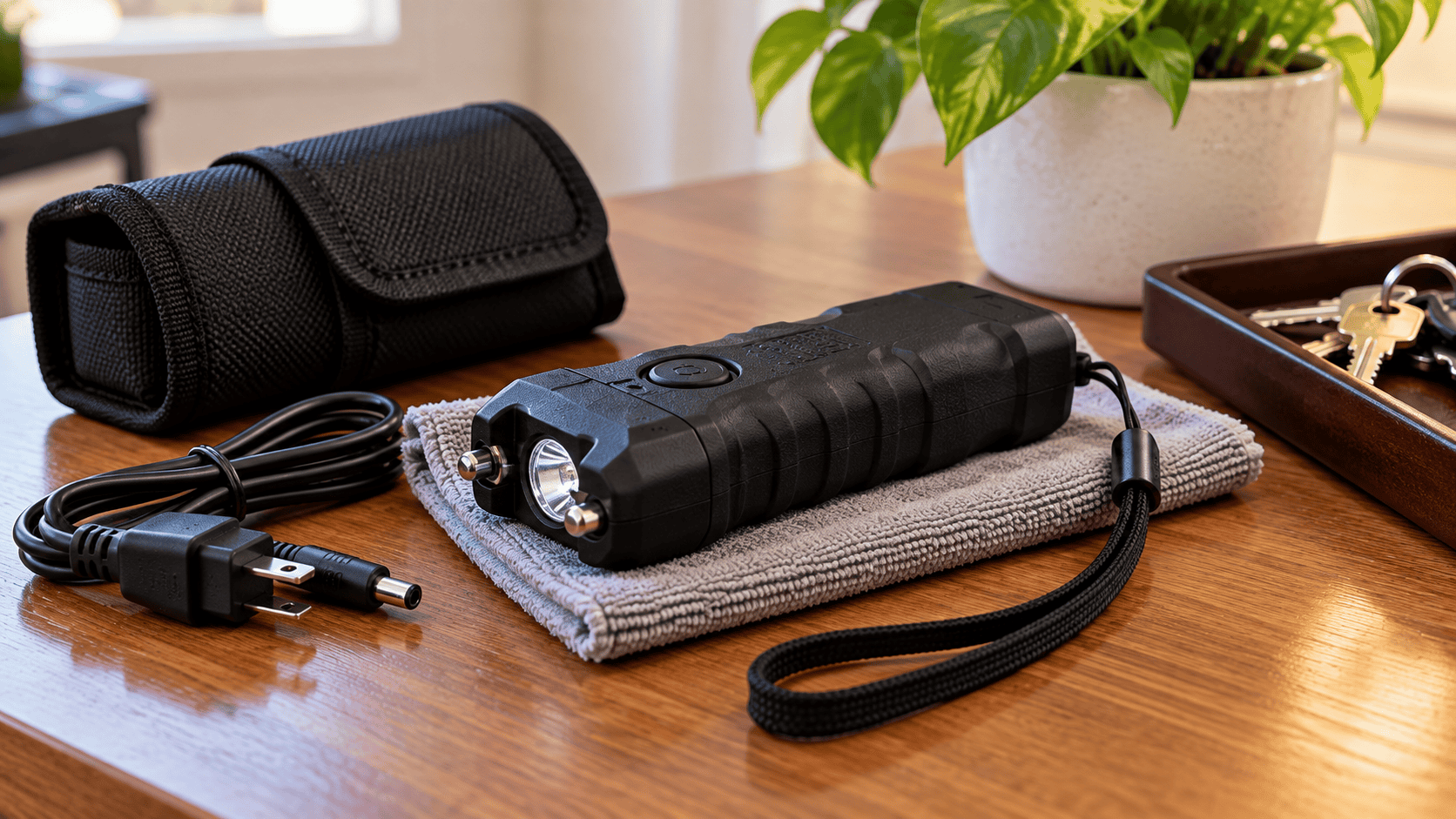
So tell me about stun gun maintenance tips.
Well, a stun gun doesn’t usually require complicated maintenance, but it shouldn’t simply be tossed into a drawer and forgotten either. Like other battery-powered personal safety devices, it benefits from periodic inspection, appropriate charging, sensible storage, and basic care.
Quick Answer: To maintain a stun gun, follow the manufacturer’s charging or battery-replacement instructions, inspect the device periodically for damage or wear, keep it clean and dry, and store it securely under appropriate conditions. There isn’t one maintenance or charging schedule that applies to every stun gun, so the instructions for your particular model should take priority over generic advice.
Maintenance is primarily about keeping the device in suitable condition and recognizing potential problems before you depend on it.
Batteries lose charge, rechargeable batteries age, switches and charging connections can become damaged, and storage conditions can affect electronic devices over time. A stun gun that hasn’t been inspected for months or years may not be in the same condition as when it was originally purchased.
Routine care doesn’t guarantee how a stun gun will perform in a particular situation. It simply helps you identify obvious problems and care for the device according to its design.
One of the most important maintenance rules is also one of the simplest: follow the instructions supplied with your particular stun gun.
Different models may use rechargeable internal batteries, replaceable batteries, proprietary charging cords, built-in charging plugs, or other power systems. Recommended charging practices and storage instructions can therefore vary.
A generic schedule such as “charge every month” or “recharge every two months” shouldn’t automatically be applied to every device. Use the manufacturer’s guidance for charging intervals, charging time, battery replacement, testing, cleaning, and storage whenever that information is available.
If your stun gun uses a rechargeable battery, use the charging method specified for that model. Make sure the charging connection and cord are in good condition and that the device isn’t visibly damaged before connecting it to power.
Avoid assuming that a charger or cable is compatible simply because it physically fits. If a replacement is necessary, verify compatibility with the manufacturer or product documentation.
Pay attention to unusual battery or charging behavior. Excessive heat, swelling, leakage, physical damage, an unusual odor, or other obvious signs of battery trouble are reasons to stop using or charging the device and consult the manufacturer or appropriate product guidance.
Some stun guns use replaceable batteries instead of an internal rechargeable power source. Use the battery type specified for the device and install it according to the manufacturer’s instructions.
If a device will be stored for an extended period, check the manufacturer’s recommendations regarding battery removal and long-term storage. Batteries can deteriorate over time, and leakage or corrosion can damage electronic equipment.
For a deeper discussion of rechargeable and replaceable power systems, see our guide to stun gun battery life and battery care.
Store a stun gun in a secure location where it is protected from moisture, excessive heat or cold, physical damage, and unauthorized access.
Avoid leaving the device where it can be crushed, dropped, exposed to liquids, or subjected to extreme temperatures. Vehicles, garages, sheds, and other locations can experience substantial temperature changes, so consider the manufacturer’s recommended storage conditions before leaving a stun gun there for long periods.
The device should also be stored in a way that reduces the chance of accidental activation. Use its safety mechanism as intended, and keep it inaccessible to children and other unauthorized users.
Stun guns generally don’t need an elaborate cleaning routine. If the exterior becomes dusty or dirty, first make sure the device is turned off or otherwise placed in its safe condition according to the manufacturer’s instructions.
Follow the manufacturer’s cleaning recommendations. Avoid immersing the device in water or allowing moisture to enter switches, charging connections, openings, or other electronic components.
Be cautious about applying solvents, disinfectants, lubricants, or other chemicals unless the manufacturer specifically indicates that they are appropriate. A product that is safe for one housing material or electronic device isn’t necessarily suitable for another.
A quick visual inspection can reveal problems that shouldn’t be ignored. Look over the housing, controls, charging components, electrodes, and any safety mechanisms for obvious damage or unusual wear.
Depending on the model, things worth noticing may include cracks in the housing, loose components, damaged switches, corrosion, damaged charging connections, or problems with a wrist strap or disable pin.
If your stun gun uses a disable-pin wrist strap, make sure the strap, attachment point, and pin remain in suitable condition. Our Stun Gun Safety Features guide explains how disable pins and other common safety mechanisms work.
Follow the manufacturer’s instructions regarding functional testing. Brief activation may be recommended for some models as a way to confirm operation, but unnecessary or repeated activation can consume battery power and isn’t a substitute for proper inspection and charging.
Don’t assume that a loud crackling sound or visible electrical arc proves everything about the condition or effectiveness of the device. Those signs can indicate that the stun gun is producing an electrical discharge, but they don’t provide a complete diagnostic test.
The electrical crackle produced by many stun guns is noticeable, which can make it tempting to use sound alone as a battery gauge. That’s not a precise way to determine battery condition.
If the device has a battery or charging indicator, use it according to the manufacturer’s instructions. Otherwise, follow the recommended charging or battery-replacement procedure for the model rather than waiting until the device sounds different.
The stun gun itself isn’t the only thing that can experience wear. If you regularly carry the device, periodically inspect its holster, case, belt attachment, wrist strap, charging cable, and other accessories.
A worn holster or damaged attachment point can make a perfectly functional stun gun inconvenient or insecure to carry. Replacement accessories should be compatible with the particular model whenever compatibility matters.
Visible damage or abnormal behavior shouldn’t simply be ignored. Stop using or charging the device if you notice signs such as serious housing damage, battery swelling or leakage, excessive heat during charging, damaged electrical connections, or controls and safety mechanisms that no longer operate normally.
If you’re unsure whether a damaged device remains safe to use, consult the manufacturer or seller rather than attempting to open or repair electrical components yourself.
You don’t need a complicated maintenance calendar. A practical routine can be as simple as:
The goal isn’t constant maintenance. It’s simply to avoid discovering after a long period of neglect that the device or its battery has developed an obvious problem.
There isn’t one charging interval that applies to every stun gun. Follow the manufacturer’s instructions for your particular rechargeable model rather than relying on a universal monthly or quarterly schedule.
Charging systems vary by model, so follow the manufacturer’s recommended charging time and procedure. Don’t assume that every stun gun is designed to remain connected to a charger indefinitely.
Follow the manufacturer’s cleaning instructions and keep moisture away from electronic components and charging connections. Avoid using solvents, lubricants, or other chemicals unless they are specifically recommended for the device.
Store it securely in accordance with the manufacturer’s recommendations, protected from moisture, extreme temperatures, physical damage, children, and unauthorized users.
Follow the manufacturer’s recommendations for functional testing. Repeated unnecessary activation can consume battery power, and visible sparks or a crackling sound shouldn’t be treated as a complete test of device condition or performance.
There is no universal replacement age. Significant physical damage, abnormal battery behavior, damaged charging components, or controls and safety mechanisms that no longer function properly are reasons to stop using the device and seek manufacturer guidance.
Maintaining a stun gun is mostly a matter of sensible battery care, appropriate storage, periodic inspection, and following the instructions for the particular device you own. It doesn’t require complicated cleaning procedures or a universal maintenance calendar.
Keep the device clean and dry, pay attention to battery and charging condition, inspect safety mechanisms and accessories for wear, and don’t ignore obvious damage. A few simple habits can help you keep track of the condition of your stun gun without relying on arbitrary maintenance rules that may not apply to your model.







We use cookies to improve your experience on our site. By using our site, you consent to cookies.
Manage your cookie preferences below:
Essential cookies enable basic functions and are necessary for the proper function of the website.
These cookies are needed for adding comments on this website.
Statistics cookies collect information anonymously. This information helps us understand how visitors use our website.
Google Analytics is a powerful tool that tracks and analyzes website traffic for informed marketing decisions.
Service URL: business.safety.google (opens in a new window)
