
U.S. Legal in Most States • Discreet Shipping • Real-World Protection • No Permits Required in Most Areas
U.S. Legal in Most States • Discreet Shipping • Real-World Protection • No Permits Required in Most Areas
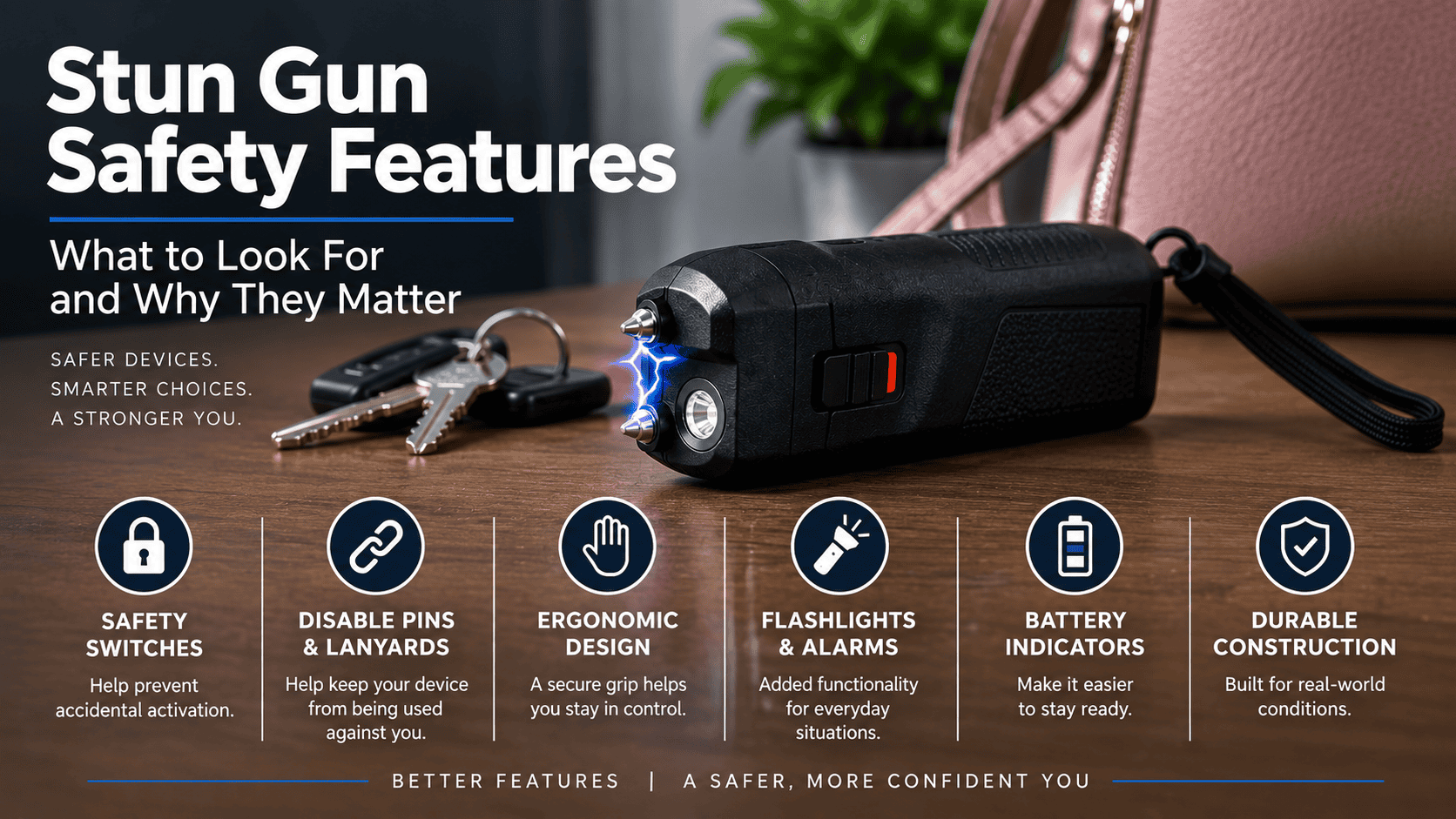
Stun gun safety features can be easy to overlook when you’re comparing models. Flashlights, rechargeable batteries, size, appearance, and other features tend to get more attention, but the way a device is designed to help prevent accidental activation or unauthorized use can be just as important.
Not every stun gun includes the same safeguards, and similar-looking features may operate differently from one model to another. That’s why understanding what those features actually do is more useful than simply looking for the longest list of specifications.
Here are some of the most common stun gun safety features you may encounter and what to consider when comparing them.
One of the most basic stun gun safety features is a switch or control designed to keep the device from activating unintentionally.
Depending on the model, you may need to move a safety switch into an armed position before the activation button will operate. Other devices use different arrangements or multiple controls.
The important point isn’t that one particular switch design is always better. It’s that you understand how the safety mechanism on your particular stun gun works before you begin carrying it.
A safety feature isn’t very useful if you’re constantly defeating it because the controls are inconvenient, or if you don’t know whether the device is in its safe or operational position.
Some stun guns include a removable disable pin connected to a wrist strap or lanyard. The basic idea is simple: if the pin is removed from the device, the stun gun becomes inoperable until the pin is reinserted.
When used according to the manufacturer’s instructions, this can provide an additional safeguard if the device becomes separated from the person carrying it.
But don’t assume every wrist strap is a disable-pin system. Some straps are simply retention lanyards. Check the manufacturer’s description and instructions to determine exactly what your model includes and how it functions. You can learn more about replacement disable pins, holsters, and related equipment in our stun gun accessories guide.
If your stun gun does use a wrist strap with a disable pin, include the strap and its attachment point in your normal inspection of the device. Look for obvious wear, fraying, damage, or a loose connection, and make sure the disable-pin system remains in the condition specified by the manufacturer. If the strap, pin, or attachment point appears damaged, replace the appropriate part rather than assuming the safety feature will continue to function as intended.
Safety isn’t limited to switches and pins. The physical design of a stun gun also affects how securely and comfortably you can handle it.
Grip shape, texture, control placement, size, and weight can all influence whether a particular model feels manageable in your hand. A larger device may feel secure to one person while a smaller model may be more comfortable for someone else.
This is one reason there isn’t a single stun gun design that’s automatically best for everyone. When comparing models, consider whether you can comfortably hold the device and operate its normal controls without awkwardly changing your grip.
Many stun guns include features that aren’t part of the electrical function at all. Built-in LED flashlights are common, and some models may also incorporate an audible alarm.
A flashlight can be useful for ordinary visibility — finding a keyhole, looking inside a vehicle, illuminating a walkway, or simply seeing more clearly in a dark area. An alarm, where included, can provide another way to attract attention.
These shouldn’t be confused with safeguards such as safety switches or disable pins. They’re additional functions rather than mechanisms intended primarily to prevent unintended operation.
A stun gun that’s been sitting unused for months still needs to be maintained according to its manufacturer’s recommendations.
Some rechargeable models include indicator lights or other features related to charging or battery status. These can make it easier to understand the condition of the device, but their meaning varies by model.
Don’t assume that a particular light means a battery is fully charged unless the instructions say so. Likewise, avoid applying a generic charging schedule to every rechargeable stun gun. Follow the recommendations for the specific device you own.
A personal safety device may spend considerable time in a purse, bag, vehicle, holster, drawer, or other storage location. That makes basic construction quality worth considering.
Look at the housing, switches, charging components, lanyard attachment points, and other parts you will regularly handle. If the manufacturer makes specific claims about water resistance, dust resistance, impact resistance, or other environmental protection, check what those claims actually mean rather than assuming the device is weatherproof.
Unless a manufacturer specifically rates a stun gun for particular environmental conditions, it makes sense to protect an electronic device from unnecessary moisture, extreme temperatures, impacts, and other conditions that could damage it.
Voltage numbers are among the most heavily promoted specifications in the stun gun market, but a large number printed on a package doesn’t tell you everything about the quality, safety, or suitability of a device.
When you’re comparing stun guns, consider the entire product: its controls, safety mechanisms, construction, size, charging system, manufacturer instructions, and how practical it is for the way you intend to carry and store it.
No specification should be interpreted as a guarantee of what will happen in a real-world self-defense situation. Circumstances vary, and no personal safety product guarantees protection.
Built-in safeguards don’t replace responsible ownership. Before carrying a stun gun, read the manufacturer’s instructions and become familiar with its controls in a safe environment. Our guide on stun gun safety training looks more closely at familiarization, safe handling, storage, maintenance, and training options.
Know how to place the device in its safe condition, how its charging system works, and what any indicator lights mean. If it has a disable pin, understand how to insert and remove it properly. If something appears damaged or isn’t operating normally, don’t continue relying on the device until the problem has been addressed.
Storage matters too. A stun gun should be secured against accidental activation and unauthorized access, particularly around children. At the same time, think realistically about how and where you intend to carry it rather than assuming that every storage arrangement works equally well. For a broader look at preparation, carrying, maintenance, legal considerations, and emergency situations, see our guide on how to use a stun gun for self defense responsibly.
There isn’t one feature checklist that makes a stun gun right for everyone. Instead, think about which features address the way you expect to carry, store, maintain, and use the device.
The best combination isn’t necessarily the device with the most features. It’s the one whose features you understand and that fits realistically into your personal safety plan.
There isn’t one feature that’s most important for every model or every user. A well-designed safety switch or activation system is fundamental, but a disable pin, secure grip, understandable controls, and proper storage can also contribute to safer ownership.
On models equipped with one, removing the disable pin makes the stun gun inoperable until the pin is reinserted. These pins are often connected to a wrist strap or lanyard. Always check the manufacturer’s instructions because designs vary.
No. Some wrist straps are simply retention lanyards. Don’t assume that removing a strap will disable a stun gun unless the manufacturer specifically identifies it as a disable-pin system.
A built-in flashlight can be a useful personal safety feature because it provides illumination, but it isn’t the same type of safeguard as a safety switch or disable pin. Its primary function is providing light rather than preventing unintended activation.
Not necessarily. A voltage claim doesn’t tell you what safety mechanisms, controls, construction, charging system, or other features a stun gun includes. Evaluate the complete device rather than using one specification as a shortcut for overall quality or suitability.
Stun gun safety features are worth understanding before you choose or carry a device. Safety switches, disable pins, ergonomic designs, battery indicators, flashlights, alarms, and durable construction can all serve different purposes.
More features aren’t automatically better. What matters is understanding the features your stun gun actually has, knowing how they work, and following the manufacturer’s instructions for handling, charging, maintenance, and storage.
A stun gun is only one possible part of a broader personal safety plan. Built-in safety features can make a device more practical and help reduce unintended operation, but they don’t replace awareness, responsible handling, good judgment, or appropriate storage.
Until later…..







We use cookies to improve your experience on our site. By using our site, you consent to cookies.
Manage your cookie preferences below:
Essential cookies enable basic functions and are necessary for the proper function of the website.
These cookies are needed for adding comments on this website.
Statistics cookies collect information anonymously. This information helps us understand how visitors use our website.
Google Analytics is a powerful tool that tracks and analyzes website traffic for informed marketing decisions.
Service URL: business.safety.google (opens in a new window)