U.S. Legal in Most States • Discreet Shipping • Real-World Protection • No Permits Required in Most Areas
U.S. Legal in Most States • Discreet Shipping • Real-World Protection • No Permits Required in Most Areas
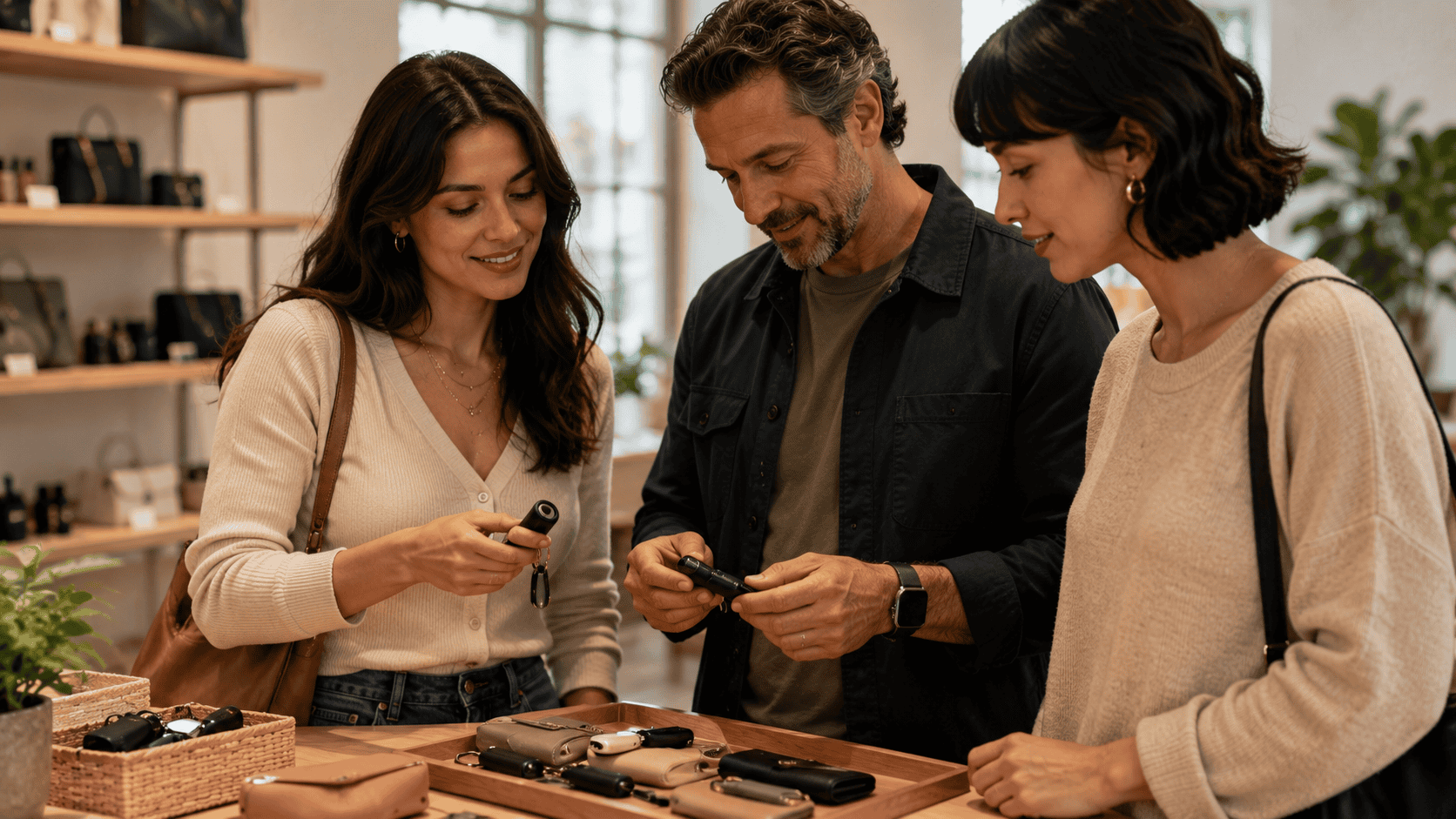
Quick Answer: Non-lethal self defense products are tools designed to stop or deter a threat without causing permanent injury or death. They include pepper spray, stun guns, personal alarms, tactical pens, and more. Each with different strengths depending on your lifestyle, environment, and comfort level. Choosing the right one comes down to understanding how each tool works and being willing to practice with it.
Non-lethal self-defense tools work by creating enough of a physical or psychological disruption to allow you to get away from danger. They don’t require martial arts training or extraordinary strength. They’re designed for regular people in real-world situations. The goal isn’t to win a fight. It’s to create an opportunity to escape and get to safety.
These products have been around for decades. And the options today are more reliable, more accessible, and more practical than ever. Whether you’re a college student walking to your car after a late class. Or a parent dropping kids off at soccer practice, there’s likely a non-lethal tool that fits naturally into your daily routine. The key is finding the right fit before you ever need it.
Pepper spray is one of the most widely used and well-proven non-lethal self-defense tools available. It works by releasing oleoresin capsicum – a chemical compound derived from hot peppers. Which causes intense burning in the eyes, nose, and throat, temporary blindness, and difficulty breathing. Most formulas take effect in seconds and the effects can last anywhere from 20 minutes to over an hour.
Effectiveness depends on the formula, the delivery pattern, and how close you are to a threat. Cone spray patterns are good for close-range defense, stream patterns reduce blowback in windy conditions, and gel formulas stick to a target and are harder to wipe off. For most people, a compact keychain pepper spray in a gel or stream formula is an excellent everyday carry option.
One thing I always tell people: buy two. Keep one for everyday carry and use the second one to practice your draw. Knowing how to deploy your spray quickly and confidently under stress is just as important as having it with you in the first place.
Stun guns and Tasers are both electroshock devices, but they work very differently. A stun gun requires direct contact – you press it against an attacker’s body and deliver an electrical charge that disrupts muscle function and causes significant pain. Tasers, on the other hand, fire two probes on wires that can reach a target from a distance – typically 15 feet or more – delivering the same type of neuromuscular disruption from across a room.
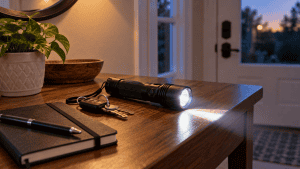
Stun guns are generally less expensive and widely available. They’re compact, easy to carry, and come in forms that look like everyday objects – flashlights, lipstick tubes, or even phone cases. The trade-off is that you have to be within arm’s reach to use one, which means the situation has already escalated to close contact.
Tasers offer standoff distance, which is a meaningful advantage. However, they tend to cost more, and if you miss or only one probe connects, the device may not function as intended. For most people, a stun gun paired with pepper spray gives solid layered coverage – distance deterrence plus a contact backup.
Personal safety alarms are small devices that emit an extremely loud siren – typically 120 to 140 decibels – when activated. They don’t physically stop an attacker, but they do two important things: they draw immediate attention to your situation, and they often startle or discourage an attacker who wasn’t expecting noise.
These are an excellent option for people who aren’t comfortable carrying chemical or electrical tools, including children, older adults, and people with physical limitations. They’re also a smart addition to any safety setup because they require zero training and have essentially no risk of misuse. Many people attach them to a keychain or backpack zipper so they’re always within reach.
Don’t underestimate the alarm. In a crowded area, a 130-decibel blast is genuinely disorienting. In a quiet parking structure at night, it can bring help running from half a block away.
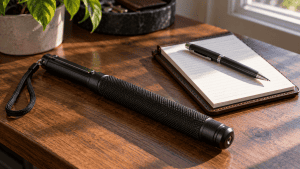
Tactical pens are heavy-duty writing instruments made from aircraft-grade aluminum or steel. They write like a normal pen, but they’re built to be used as a striking tool in a close-range confrontation. The reinforced tip can be used to target pressure points or deliver a focused strike to break a grip. Kubotans are short, rounded rods – often attached to a keychain – that serve a similar function, amplifying the force of a strike and helping with pressure point techniques.
These tools require more physical engagement than pepper spray or alarms, which means some basic understanding of how to use them is helpful. That said, they offer a significant advantage: they travel anywhere. A tactical pen goes through airport security without question and into any workplace. For frequent travelers or people in environments where other tools aren’t permitted, they’re worth serious consideration.
Pepper gel is a thicker, stickier version of traditional pepper spray. It reduces airborne particles – which means less risk of blowback affecting you – and it clings to a target rather than dispersing into the air. This makes it a popular choice for indoor use and for people who are concerned about affecting bystanders.
Mace is a brand name that has become a generic term, but modern Mace products typically combine OC (oleoresin capsicum) with tear gas compounds for a stronger combined effect. Some combination sprays also add UV marking dye, which is invisible at the time of use but glows under blacklight – a useful detail if law enforcement needs to identify someone later.
If you’re looking for a single everyday carry spray and you live or work indoors a lot, pepper gel is probably your best starting point. If you spend significant time outdoors, a stream formula with UV dye is a solid all-around choice.
Laws vary significantly by state, county, and even city. Pepper spray, for example, is legal for civilian use in all 50 states, but some states have restrictions on canister size, concentration, or who can purchase it. Stun guns and Tasers are restricted or prohibited in certain states. Tactical pens and kubotans generally have fewer legal restrictions, but some jurisdictions classify them as weapons depending on context.
Before you carry any self-defense tool, it’s worth spending fifteen minutes looking up the laws in your specific state and municipality. This isn’t a reason to avoid these products – it’s just part of being a responsible, prepared person. Most restrictions are minor and easy to work around once you know about them.
Start with your actual daily life, not a hypothetical worst-case scenario. Where do you spend most of your time? Do you commute? Work in an office? Walk or run alone? Travel frequently? The tool that’s always with you is always more valuable than the one you left at home because it was too bulky or inconvenient.
Think through these practical factors:
There’s no single perfect answer, and that’s okay. A thoughtful choice that you actually carry every day is far more valuable than the theoretically best option sitting in a drawer.
Yes, but with some care. Traditional spray formulas can create airborne particles that may affect you or others nearby. Pepper gel is a better option for indoor use because it doesn’t atomize into the air the same way. If you spend most of your time indoors – at home, in an office, or in a parking garage – gel is worth choosing specifically for that reason.
Generally, yes. Most stun guns are effective through standard clothing like t-shirts, jeans, or light jackets. Heavy winter coats, leather, or very thick layers can reduce effectiveness. For the best results, target areas where clothing is thinner – the neck, upper arms, or lower torso. A reliable stun gun should still deliver a meaningful shock through most everyday clothing.
Most pepper spray products have a shelf life of two to four years. The expiration date is usually printed on the canister. Over time, the propellant degrades and the spray may not deploy with the same force or distance. Check your canister periodically, replace it before it expires, and use the old one for practice so you understand how it sprays and deploys in real conditions.
In truly isolated settings, an alarm is limited. Its primary value is in populated or semi-populated areas where the noise draws attention and creates social pressure on an attacker. If you frequently find yourself in remote or isolated environments, an alarm should be paired with a more active deterrent like pepper spray or a stun gun for layered protection.
Formal training isn’t required for most of these tools, but some practice is always worthwhile. At a minimum, you should know how to access your tool quickly under stress, understand its effective range, and be aware of any safety mechanisms. For stun guns and tactical pens, a basic self-defense class adds real value. For pepper spray and alarms, practice drawing and deploying them until it feels natural.
Absolutely, and for many people it makes sense to do so. A common combination is a personal alarm plus pepper spray – the alarm creates immediate noise and attention, while the spray provides active deterrence. Just make sure you can access each tool quickly and know which one you’re reaching for in a high-stress moment. Simplicity and speed matter more than having many options.
For most college students, a compact pepper gel on a keychain is the most practical starting point. It’s affordable, easy to carry, requires minimal training, and is effective in the kinds of situations college students are most likely to encounter – walking alone at night, in parking lots, or on campus paths. Adding a personal alarm to the keychain gives an extra layer of passive deterrence with no additional effort.
Having a non-lethal self-defense tool doesn’t mean you’re expecting trouble. It means you’ve made a calm, thoughtful decision to be prepared – the same way you keep a first aid kit in your car or a flashlight by the door. These tools are about confidence and readiness, not fear.
Take your time, understand what you’re working with, and choose something you’ll actually carry. That single decision – to be prepared – is more valuable than any product on its own. If you have questions about any of the tools covered here, I’m always happy to help you think through what makes the most sense for your situation.





We use cookies to improve your experience on our site. By using our site, you consent to cookies.
Manage your cookie preferences below:
Essential cookies enable basic functions and are necessary for the proper function of the website.
These cookies are needed for adding comments on this website.
Statistics cookies collect information anonymously. This information helps us understand how visitors use our website.
Google Analytics is a powerful tool that tracks and analyzes website traffic for informed marketing decisions.
Service URL: business.safety.google (opens in a new window)