

U.S. Legal in Most States • Discreet Shipping • Real-World Protection • No Permits Required in Most Areas
U.S. Legal in Most States • Discreet Shipping • Real-World Protection • No Permits Required in Most Areas

For delivery van drivers, the best personal safety devices are compact personal alarms in the 120–130dB range, clip-on or wearable form factors that stay accessible without requiring two free hands, and secondary tools like keychain stun guns that deploy fast in confined quarters. The van environment demands tools that activate instantly, don’t require line-of-sight, and function effectively in spaces under 100 cubic feet where a physical confrontation leaves almost no room to maneuver.
Delivery drivers aren’t walking a beat with backup nearby. When the rear doors open at a stop in an unfamiliar neighborhood — at 6 AM or 10 PM — the response window is short and the workspace is restrictive. A full-size pepper spray canister buried in a bag is useless. What works here is what’s already in your hand, already clipped to your body, or mounted within reach in the cab. The tools covered here are selected specifically for confined-space utility: fast activation, hands-optional alerting, and deterrence output powerful enough to change the threat calculus immediately.
A standard cargo van interior — whether a sprinter, transit, or step van — eliminates the advantages that open environments provide. You cannot run. You cannot easily create distance. Your peripheral vision is blocked by shelving, packages, and the vehicle’s own structure. Anyone who enters the cargo area behind you controls the exit. That’s not a scare tactic — it’s a spatial reality that dictates which tools can realistically help you.
The cab offers marginally more control, but not much. Sitting in a driver’s seat means your mobility is reduced to roughly a 90-degree arc. Your dominant hand may be on a package, a scanner, or a door handle. Any tool that requires a two-handed draw, a safety cap removal, or deliberate aiming fails the operational test in this environment.
The threat profile for delivery drivers is also distinct. According to Bureau of Labor Statistics data, delivery and courier workers face higher-than-average rates of workplace violence — and that’s before accounting for unreported incidents at residential stops. The combination of predictable routes, known delivery windows, and isolated stop locations creates conditions that require deliberate preparation, not generic self-defense advice.
Output and activation speed are the two specifications that separate effective alarms from shelf filler. In a tight space, a 130dB alarm is not just loud — it is physiologically disorienting to anyone within 10 feet. At that decibel level, sustained exposure causes immediate discomfort and overrides rational decision-making. That reaction buys you seconds. Seconds are what you need to exit, create distance, or escalate your response.
Activation must be single-action and operable under stress. A personal safety siren with a pull-pin or push-button activation is deployable with one hand, without looking at the device. That matters enormously when your other hand is occupied with a package or braced against a door frame. Anything that requires two hands, a twist-unlock mechanism, or deliberate visual confirmation is not appropriate for this use case.
Clip-on form factors solve the access problem directly. A clip-on personal alarm attached to a belt loop, waistband, or bag strap is on your person throughout the shift without thought. You don’t have to remember it. You don’t have to reach for it. It moves with you from cab to cargo area to front door and back. That continuity of access is non-negotiable in a mobile work environment where you’re entering and exiting the vehicle dozens of times per shift.
A personal alarm watch takes this principle further — the device is literally on your wrist, inaccessible to a grab attempt directed at a belt or bag. For drivers who handle high-value deliveries or work late hours in variable neighborhoods, wrist-mounted alerting is worth serious consideration.
The constraint is space. Tools that require a full arm extension, a wide arc, or accurate directional aim lose most of their effectiveness inside a cargo area or cab. That eliminates many standard-format options and elevates compact, close-quarters tools to the top of the list.
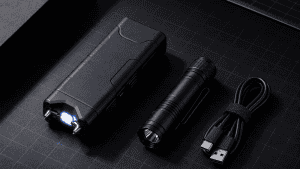
Compact stun guns in the keychain format — including options like the Runt or Shorty from Streetwise — operate at contact range and require no aiming. You press, you activate. In a confined space, that’s a significant tactical advantage over ranged tools that require clearance. The Runt delivers between 20–80 million volts depending on the variant, in a form factor small enough to hold in a closed fist. It’s operational before anyone in the van knows you’ve drawn anything. If you’re new to stun gun handling, review the foundational protocols in our guide on how to use a stun gun without hurting yourself before adding one to your kit.
Keychain pepper sprays — particularly Pepper Shot and WildFire formulations — provide approximately 10-foot effective range with a stream or gel pattern that limits blowback in an enclosed cab. Gel is specifically preferable in confined spaces because it binds to the target rather than aerosolizing into the space you’re occupying. Mace also offers compact keychain options with built-in UV dye for later identification. Any of these are viable secondary tools for the cab environment when mounted on a visor clip or attached to the ignition key ring.
What does not work reliably inside a van: telescoping batons (require swing clearance), full-size spray canisters (slow draw from bags), and any tool without a dedicated carry position. If it’s not on your body or within a 6-inch reach from your work position, it doesn’t count as accessible under operational conditions.
Zone-based organization is the professional standard. Assign every tool a fixed position and train to that position. The goal is muscle-memory access — you reach for the device the same way every time, whether the shift started two hours ago or ten hours ago, whether you’re tired, rushed, or caught off guard.
Zone 1 — On body: Primary alarm (clip-on or wristwatch). Always present, always accessible. This is your immediate-response layer.
Zone 2 — Cab reach: Secondary deterrent (compact pepper spray or stun gun) mounted on or within 6 inches of the driver’s position. Visor clip, center console cup holder, or magnetic mount. Accessible without leaning, digging, or visual search.
Zone 3 — Cargo area: If your route involves extended time in the cargo area organizing packages, a second alarm — pull-pin activated — mounted near the rear doors gives you a fixed-position option when your body-worn tool is occupied. A 130dB alarm triggered at the rear of a van is audible 200–300 feet away in most urban environments.
Run through your zone check at the start of every shift, not just once when you first set up. Tools get moved. Batteries die. A 30-second confirmation that every zone is loaded is standard operational discipline.
Alarms are your first line, not your only line. Their function is deterrence and attention-drawing — both critical at the moment of threat. A 130dB alarm activated in a residential neighborhood at any hour produces an immediate public response. That alone is often enough to abort an opportunistic threat. Criminals seeking an easy score do not want noise and witnesses.
But alarms do not stop a determined physical threat. That’s where a secondary contact-range tool — compact stun gun or pepper spray — closes the gap. The combination of an activated alarm (drawing attention) and a deployed deterrent (creating immediate physical deterrence) is substantially more effective than either tool alone. Layered response is the professional approach.
For drivers who log significant solo hours and cover high-risk routes, personal alarms designed for high-mobility use cases offer features like extended battery life, weather resistance, and dual-activation modes that consumer-grade options don’t match. The specifications matter when you’re relying on a device across a 10-hour shift in variable conditions.
Trust the read. If a stop feels wrong — poor lighting, someone loitering near the vehicle, a location that doesn’t match the address details — you have no obligation to proceed as if everything is normal. Drive forward, contact dispatch, and document the stop. No package is worth the alternative outcome.
If you’re already outside the vehicle and a situation escalates: activate your alarm immediately. Do not wait for certainty. A false alarm is recoverable. The primary goal is to create noise and attention before physical contact occurs. Get back to the cab. Lock the doors. Call 911. Your company’s dispatch is secondary — law enforcement first, always.
In the cargo area, your priority is exiting to the cab or to open space. A confined space removes your options; open space restores them. If your path to exit is blocked, an activated alarm and a deployed deterrent give you time and distance to create an opening.
For workers in other solo-operation professions facing similar threat profiles, the tactical frameworks we covered for real estate agents who show homes alone translate directly — isolated environment, unpredictable contact with strangers, no backup nearby.
130dB is the minimum effective threshold for a confined-space alarm. At that output, the sound is physically disorienting at close range and audible 200–300 feet away in open environments. Alarms below 120dB are measurably less effective at producing the immediate involuntary response you need in a tight space with ambient vehicle and street noise present.
Gel-formula pepper spray is the correct choice for enclosed environments. Unlike aerosol or fog formulas, gel binds directly to the target on contact rather than dispersing into the surrounding air. This significantly reduces the risk of self-contamination in a cab or cargo area. Stream formulas are a secondary option. Avoid fog or cone patterns in any enclosed space.
Two positions: on your body (clip or wrist) for primary access, and within 6 inches of your standard cab position for your secondary device. A visor clip, center console mount, or carabiner on the gear shift are all valid secondary positions. The criterion is: can you reach and activate it in under two seconds without looking for it?
Stun gun legality varies by state and sometimes by municipality. Most U.S. states permit civilian carry with minimal or no restriction, but several states require permits or prohibit them entirely. Verify the laws in every state your route covers — not just your home state. Your employer’s company policy may also impose restrictions independent of state law.
Activation speed and carry position. A 130dB alarm that takes four seconds to locate and activate is operationally inferior to a 120dB alarm already clipped to your body. The device you can deploy in under two seconds, one-handed, without visual confirmation is the right device — regardless of what the spec sheet says about output.
Battery-powered alarms should be checked weekly at minimum — daily if you’re working extended hours or adverse weather conditions. Rechargeable stun guns should be fully charged before each shift. Treat the charge check the same as checking your fuel or package manifest — it’s pre-shift confirmation, not optional maintenance. Keep a backup battery or spare alarm in the cab for extended routes.
Review your employment agreement and company policy before carrying. Many logistics companies explicitly address personal safety tools in their driver guidelines. Where company policy is silent, a direct conversation with a supervisor or HR contact is the professional approach. Carrying without disclosure on a route that prohibits it creates liability exposure for you, not protection.
Yes — 130dB exceeds typical urban ambient noise levels (70–90dB in most city environments) by a significant margin. The alarm does not need to be heard clearly at distance to be effective; it needs to be immediately disruptive at close range to the threat. At 130dB and 5–10 feet, that threshold is reliably met regardless of street noise background.
Delivery drivers operating solo routes have one non-negotiable professional obligation: take your personal safety as seriously as your delivery schedule. The tools exist. They are compact, affordable, and proven. A 130dB alarm clipped to your waistband and a gel-formula pepper spray mounted in your cab cost less than thirty dollars combined and take zero time to deploy when they’re in the right position. That is not a complicated calculation. Make the decision, configure your zones, and run your shift with the confidence that comes from being prepared — not the anxiety that comes from being caught without options. Browse our full selection of high-performance personal alarms built for people who move, work, and can’t afford a slow draw.






We use cookies to improve your experience on our site. By using our site, you consent to cookies.
Manage your cookie preferences below:
Essential cookies enable basic functions and are necessary for the proper function of the website.
These cookies are needed for adding comments on this website.
Statistics cookies collect information anonymously. This information helps us understand how visitors use our website.
Google Analytics is a powerful tool that tracks and analyzes website traffic for informed marketing decisions.
Service URL: business.safety.google (opens in a new window)
