

U.S. Legal in Most States • Discreet Shipping • Real-World Protection • No Permits Required in Most Areas
U.S. Legal in Most States • Discreet Shipping • Real-World Protection • No Permits Required in Most Areas
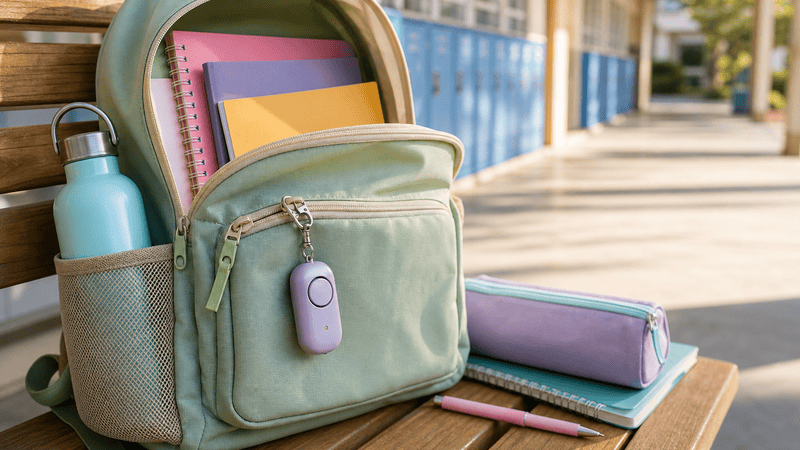
The personal alarm that belongs in a child’s backpack is a compact, clip-on device rated at 120–130dB that activates by pulling a pin or pressing a button — no training required, no phone signal needed, and no age restriction on use. One that clips to a zipper pull or bag strap is immediately accessible. A wrist-strap lanyard model adds a second carry option for walkers and cyclists. Choose one with a built-in LED flashlight for added utility that keeps kids using it daily.
Here’s what most safety conversations about kids get backward: they start with worst-case scenarios and work down to tools. That’s the wrong direction. The right question isn’t “what happens if something goes wrong?” — it’s “what will a ten-year-old actually use, without hesitation, under stress?” That reframe changes everything about which alarm you choose, how it’s configured, and where it lives in that backpack. What follows is a tactical answer to all three.
Most safety tools require a decision tree to operate. Pepper spray requires legal age, proper grip, wind direction awareness, and the presence of mind to aim under adrenaline. A phone requires signal, an unlocked screen, and the ability to speak. A personal alarm requires one action: pull the pin or press the button. Under stress — especially the acute, disorienting stress a child experiences — single-action tools outperform multi-step tools every time.
The 120–130dB output of a quality personal alarm is the real mechanism. That sound level sits between a chainsaw (110dB) and a jet engine at 100 feet (140dB). It is involuntarily attention-seizing. Bystanders within a 600-foot radius will orient toward it. Potential threats face immediate exposure — which is precisely what most predatory behavior is designed to avoid. The alarm doesn’t need to summon police; it needs to collapse the anonymity a threat depends on.
There’s a secondary advantage specific to children: the alarm removes the freeze response from the equation. Kids who freeze under threat — a well-documented physiological reality — can still pull a pin. The motor action is simpler than shouting, running, or fighting. For school-aged children from roughly 6 to 14, this single-action mechanism represents a genuine capability gap that a personal alarm fills better than any other non-lethal tool. You can read a deeper breakdown of how these devices operate in this overview of how personal alarms work and why they’re worth carrying.
Minimum 120dB. That threshold is non-negotiable for real-world effectiveness. Below 120dB, the alarm may not cut through ambient urban noise, crowd sound, or distance. At 120dB, the alarm is audible at approximately 300–600 feet in open environments. At 130dB — the upper end of consumer-grade personal alarms — that range extends further and the physiological impact on nearby individuals is significantly more disorienting.
The Streetwise brand offers several 130dB models that meet this standard. The SMART series from Streetwise includes models with a built-in LED flashlight — a feature worth selecting specifically for children, because dual-function devices get carried consistently. A kid who uses the flashlight walking to the bus stop in November darkness keeps the alarm accessible. A dedicated alarm-only device gets buried in the front pocket and forgotten.
One specification to verify before purchasing: battery type. CR2 and CR123 batteries are less commonly available than AAA. For a child’s alarm, select a model that runs on AAA batteries or USB-rechargeable. Replacement probability increases when the battery is the same type already in the TV remote.
Exterior clip position is the only acceptable answer. An alarm inside a zipped pocket fails the single-action test. The whole mechanism depends on the device being reachable and deployable in one movement, without visual confirmation. A clip on the exterior zipper pull of the top compartment or on a side handle meets that standard. A carabiner-style clip rated to at least 50 lbs ensures the device won’t accidentally separate during normal use.
For children who walk to school or travel independently, a secondary carry position is worth configuring: a wrist-strap lanyard worn on the non-dominant wrist. This position keeps the alarm accessible even if the backpack is dropped, grabbed, or set down — which it frequently is during active transit. The wrist-strap model can be transferred from backpack to wrist during unsupervised walking segments and back again during school hours when the device needs to be low-profile.
Some alarms in the Streetwise and Mace product lines include clip hardware that functions as both a belt clip and a bag attachment. That versatility matters for school-age users whose carry context shifts multiple times throughout a single day: bus, hallway, playground, after-school activity, walk home. A device that adapts to each segment gets used across all of them.
Practice activates it; explanation alone does not. Run a dry activation drill in a controlled environment — outdoors, away from enclosed spaces — so the child experiences the actual sound output at close range. This does two things: it normalizes the device and it demonstrates that the sound is dramatic. A child who has heard 130dB in a safe context will not hesitate to deploy it under stress.
Frame the drill as capability training, not threat rehearsal. The distinction matters developmentally. “This is what you do if you feel unsafe and need help” is a fundamentally different instruction than “this is what you do if a stranger grabs you.” The first builds confidence and agency. The second builds a threat-specific script that may not generalize well to ambiguous situations — which are what most real incidents begin as.
Establish two activation rules with clear language: activate if someone is trying to grab you or pull you somewhere, and activate if you are lost and need help locating adults. The second rule doubles as a practical utility — a 130dB alarm can locate a lost child in a crowded venue faster than shouting their name. That dual framing shifts the device from emergency-only to useful-regularly, which increases the likelihood it stays in carry position rather than getting removed and left at home.
Yes — and they’re not the features most product descriptions lead with. The spec that matters most for child users is activation force: the pull resistance on a pin-style alarm should be light enough for a child’s grip strength to operate under stress. Some alarms designed for adults require meaningful force to remove the activation pin — 8 to 12 pounds of pull. For a child aged 6–10, that resistance can prevent deployment in the exact moment it’s needed.
Select models that specify a low activation force, or physically test the pull resistance before purchasing. The alarm should activate with a swift, confident tug that a child can replicate reliably. A wrist-strap model with a break-away mechanism addresses this by using body movement — stepping away from a grab — as the activation action rather than hand strength alone.
LED flashlight integration, as noted, increases daily carry consistency. Some models in the Streetwise SMART line include strobe function alongside the audible alarm — a visual component that adds a second attention-drawing mechanism in low-light environments. For children in areas where early-morning or late-afternoon transit occurs during dark winter months, the strobe adds real operational value.
For a broader look at how alarm features scale across different user profiles, the guide on personal alarms for travelers covers environmental adaptability in useful detail — many of those same criteria apply directly to a child’s variable daily environment.
The hardware specifications overlap almost entirely — 120–130dB output, pin or button activation, clip carry. The meaningful differences are in form factor, activation force, and placement strategy. Adult alarm design often prioritizes compactness at the cost of clip hardware that’s harder for smaller hands to manage. Child-optimized carry prioritizes simplicity: the alarm should clip on, stay on, and come off in one pull when needed.
Adults can tolerate a slightly complex activation sequence because trained motor patterns persist better under stress in mature nervous systems. Children’s stress responses are more likely to result in gross motor simplification — fine motor skills degrade sharply under acute fear. This makes the single-action, pull-pin mechanism categorically superior for child users compared to button-hold or multi-step activation designs.
Adults selecting alarms for themselves — particularly women and runners — navigate a similar set of criteria around accessibility and activation simplicity. The design thinking covered in resources on personal alarms for runners and personal alarms for women applies directly here, since all three user profiles prioritize single-action deployment under real-world conditions.
Most children are ready for a personal alarm at age 6–7, when they begin walking independently within limited ranges — to a bus stop, a neighbor’s house, or within a school campus. There is no minimum age restriction on personal alarms. The practical threshold is whether the child can understand two rules: when to activate it, and not to activate it as a toy. A brief practice drill confirms readiness more reliably than age alone.
Most schools permit personal alarms because they are not classified as weapons. However, policies vary by district. Check with your school’s administration before sending one in a backpack. Many parents configure the alarm to clip to the outside of the bag and keep it in the child’s locker or cubby during school hours, activating the carry protocol only during transit — before and after school, on buses, and during after-school activities.
130dB is approximately equivalent to a jackhammer at 3 feet. Brief, one-time exposure at that level does not cause permanent hearing damage but is significantly uncomfortable at close range. Children should be taught to hold the alarm away from their own face and ear during activation — arm extended, away from the body. Practice drills conducted outdoors with the alarm held at arm’s length demonstrate the correct deployment posture before it’s needed under stress.
Most AAA-battery-powered personal alarms maintain charge for 12–18 months of standby use with no activation. USB-rechargeable models vary by battery capacity but typically hold charge for several months without use. The practical maintenance schedule for a child’s alarm: check and replace or recharge at the start of each school year, and again at the January semester break. Mark the date on the alarm or inside the backpack with a permanent marker.
An accidental activation is disruptive but not dangerous. The alarm will draw immediate attention, which is its function. The child should be coached in advance on the appropriate response: turn it off immediately (reinsert the pin or release the button), and verbally tell any nearby adult “it was an accident.” This scripted response reduces the social stress of an accidental activation and ensures the child isn’t discouraged from carrying the device correctly going forward.
Yes — they serve different functions and neither replaces the other. A phone requires signal, an unlocked screen, and the ability to speak coherently under stress. A personal alarm requires one physical action and operates without infrastructure. In the scenarios where a phone is most useful — contacting parents from a known location — it outperforms an alarm. In the scenarios where an alarm is most useful — immediate threat, crowded environment, disorientation — it outperforms a phone. Both tools in the backpack represent a more complete safety posture than either alone.
Yes, and for children who commute by bike or scooter this is often a superior carry position. A carabiner-clip alarm attached to the handlebar stem or a bag mounted to the bike frame keeps it accessible without requiring the child to reach for a backpack. Verify the clip hardware is rated for outdoor temperature and vibration — cheaper clips can become brittle in cold weather. A wrist-strap model worn during the ride provides the most reliable access, since it moves with the child even if the bike is left behind.
A backpack-clipped alarm has a single point of failure: separation from the child. This is why wrist-strap carry during active transit is the stronger configuration. If the alarm is on the child’s wrist or worn on a lanyard, backpack separation doesn’t disable it. For children who resist wrist-strap wear, train the habit of transferring the alarm from the backpack clip to a jacket zipper or belt loop during unsupervised walking segments. Contact with the child — not the bag — is the correct anchor point for any safety device.
The standard backpack safety checklist — helmet, reflective strip, emergency contact card — is decades old. It was designed for a world where children moved through environments their parents could mostly predict and control. Personal alarms represent a different design philosophy: give the child a capability that works in the scenarios no checklist anticipated. A 130dB alarm clipped to the exterior of a backpack costs less than a school lunch, operates without infrastructure, and requires no more training than a ten-second drill in the driveway. That’s not a backup plan. That’s the plan.
Browse the full selection of personal alarms at Nittany Self Defense to find the right fit for your child’s carry style and daily route — and configure it correctly before the first day they walk out the door alone.




We use cookies to improve your experience on our site. By using our site, you consent to cookies.
Manage your cookie preferences below:
Essential cookies enable basic functions and are necessary for the proper function of the website.
These cookies are needed for adding comments on this website.
Statistics cookies collect information anonymously. This information helps us understand how visitors use our website.
Google Analytics is a powerful tool that tracks and analyzes website traffic for informed marketing decisions.
Service URL: business.safety.google (opens in a new window)
