
U.S. Legal in Most States • Discreet Shipping • Real-World Protection • No Permits Required in Most Areas
U.S. Legal in Most States • Discreet Shipping • Real-World Protection • No Permits Required in Most Areas

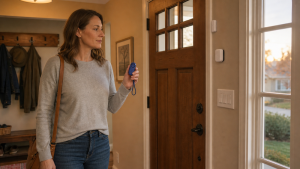
The right compact self-defense gear for a real estate agent’s bag includes a keychain stun gun, a pocket-sized pepper spray, and a high-decibel personal alarm — tools that together weigh under half a pound, fit in any tote or shoulder bag, and give you layered, reliable protection during showings, open houses, and solo walkthroughs. Each one serves a distinct purpose and none of them require a separate bag, a holster, or a tactical mindset to carry effectively.
Real estate agents spend their working days in some of the most unpredictable environments of any profession — vacant homes, unfamiliar neighborhoods, alone with strangers who made an appointment online. The risk is real and documented. What’s less documented is how easy it is to build a carry kit that actually fits your workday. This post walks you through exactly what works, what to look for in each category, and how to set up your bag so your tools are accessible when it matters.
The most effective self-defense tool is the one you have with you when something goes wrong. That’s not a cliché — it’s the central truth behind every gear recommendation on this page. A full-size pepper spray canister in your car does nothing during a showing. A stun gun buried under contracts and a laptop is inaccessible under stress. Size and placement determine whether any of this equipment functions as protection or just makes you feel better on the drive over.
Compact tools are also professional tools. Clients, colleagues, and prospects move through your workspace. A discreet carry kit doesn’t raise questions, doesn’t create awkward conversations, and doesn’t affect how people perceive you professionally. You’re not a security guard. You’re an agent who has made a quiet, intelligent decision to be prepared.
The practical target for a real estate agent’s self-defense kit: every item should fit in the outer pocket or top section of a standard tote or shoulder bag. Nothing should require digging. Total combined weight should stay under 8 ounces. That’s achievable with the right selections.
Pocket-sized pepper sprays in the half-ounce to one-ounce range deliver full stopping capability without the bulk of a patrol-style canister. Look for a flip-top safety or twist-lock mechanism that prevents accidental discharge in a bag — this is non-negotiable for everyday carry in a professional environment. A unit that fires a stream pattern rather than a cone or fog reduces cross-contamination risk in an enclosed space, which matters significantly when you’re inside a home.
Effective formulations start at 1% Major Capsaicinoids (MC) — that’s the actual heat-producing compound, not the less meaningful Scoville Heat Unit rating. Products from Pepper Shot, WildFire, and Mace all offer compact formats with verified MC concentrations. Some include UV dye for suspect identification. A 10-foot effective range is standard at this size; that’s adequate for indoor distances where a threat would realistically occur.
For a deeper breakdown of what separates effective formulations from underperforming ones in a real-world agent context, see our post on pepper spray for real estate agents — what works, what doesn’t, and what to carry. It covers stream vs. gel vs. foam delivery and why that decision matters in the environments you actually work in.
Keep your pepper spray in the outermost pocket of your bag, clip side up if it has a clip. Practice the motion of retrieving and deploying it. Muscle memory under stress is not an abstraction — it’s the difference between a tool that works and one that doesn’t.
Keychain stun guns have earned a legitimate place in the compact carry toolkit because they serve dual purposes: they’re on your person the moment you grab your keys, and they require no separate retrieval step. Models in the Runt and MultiGuard lines from Streetwise deliver 20 million to 80 million volts in packages that measure roughly 3.5 inches — smaller than most smartphones.
What separates a reliable unit from one that fails under stress? Discharge intensity, arc quality, battery type, and safety switch design. Rechargeable lithium cells outperform AAA-powered units in consistency and longevity. A safety switch that requires a deliberate two-step motion prevents accidental discharge in a bag or pocket while remaining fast to disengage when needed. The visible arc and sound produced by a quality stun gun also functions as a deterrent before contact is required.
If you’re evaluating keychain models before purchasing, the post on 5 features that separate a reliable keychain stun gun from one that fails you breaks down exactly what to verify. For agents who prefer a slightly larger handheld format with extended range capability, the compact TASER device offers 15-foot standoff distance — substantial coverage for the entry foyer or hallway situations where most agent-reported incidents occur.
Either format fits in a side pocket or clipped to a bag strap. The key is consistent placement — same spot, every day, every showing.
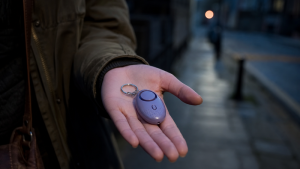
130 decibels is the functional minimum for a personal alarm to serve its purpose outdoors or in a large space. That’s equivalent to a jet engine at 100 feet — it causes immediate disorientation in an attacker and can be heard from a significant distance in a residential neighborhood. For indoor use in a vacant home, even an 85dB unit creates a disruptive acoustic environment, but 120–130dB is the range where you get both the psychological disruption and the attention-drawing effect simultaneously.
Personal alarms are the lowest-barrier tool in a real estate agent’s kit. They require no training, no physical confrontation, and no special carry position. A pull-pin activation style — where the alarm sounds when a pin is separated from the unit — is faster under stress than a button press and cannot be accidentally silenced by a grabbed hand. Clip one to your bag strap or lanyard and it’s accessible before you ever open a door.
For a full evaluation of the highest-output models designed specifically for agents who show homes solo, see our guide on the strongest personal alarms for real estate agents who show homes solo. Compact alarms in the 120–130dB range weigh under an ounce and measure about the size of a car fob. There is no reason to skip this category.
Accessibility is a system, not an accident. Set up your bag using this framework and commit to it as a professional habit — the same way you keep your business cards in a consistent location.
Outer pocket, always: Personal alarm clipped to the exterior strap or zipper pull. Pepper spray in the outer pocket, clip facing up. These are your fastest-access tools and they belong at arm’s reach, not inside the main compartment.
Keys in hand before you enter: Your keychain stun gun is on your keys. Habit of holding your keys — not just having them in your bag — means your stun gun is already in your hand during the highest-risk moment: entry into an unknown space.
Check your tools before every showing: Thirty seconds. Verify your pepper spray safety is engaged. Verify your stun gun is charged. Verify your alarm pin is secure. This is professional maintenance, not paranoia.
Tell someone where you are: Self-defense tools are one layer of a protection system. Situational awareness — knowing who is in the property, where the exits are, and who knows your location — is the layer that operates before any tool is needed. For a broader look at how technology and preparation extend your awareness before a situation develops, the post on 6 self-defense products that extend your situational awareness beyond your eyes is worth reviewing.
Yes. Several categories create problems that outweigh their utility in a professional context. Expandable batons require training to deploy effectively and are restricted or prohibited in many states. Tactical knives introduce escalation risk and significant legal exposure. Firearms require licensing, training, safe storage, and create liability considerations that vary dramatically by jurisdiction and workplace policy.
The categories that work cleanly for agents — pepper spray, compact stun guns, personal alarms — are legal in most states with minimal restriction, require no license in the majority of jurisdictions, and do not create the liability profile that edged or ballistic tools carry. That said, laws vary by state and municipality. Before carrying any self-defense tool, verify legality in the states and cities where you work. We cover legal frameworks in general terms in our post on Castle Doctrine vs. Stand Your Ground — understanding the legal context around self-defense is part of being a prepared professional.
Avoid tools that require two hands to deploy, tools without safety mechanisms, and anything that cannot be retrieved in under three seconds from your established carry position. Under stress, complexity fails.
A functional three-piece kit — compact pepper spray, keychain stun gun, and 130dB personal alarm — typically runs between $40 and $90 total depending on brand and specifications. Each tool serves a distinct purpose and none of them are redundant. This is a one-time investment that lasts multiple years with basic maintenance. Rechargeable stun guns eliminate ongoing battery costs.
Yes, and many agents do. A compact pepper spray with a keyring attachment can ride alongside a keychain stun gun without a meaningful weight or size increase. The practical limit is keeping total key weight manageable — too much weight on an ignition key causes long-term damage to the ignition cylinder. A carabiner-style split between your ignition key and your carry tools solves this cleanly.
Briefly visible tools rarely generate comments. A small pepper spray canister or keychain unit looks like standard keychain hardware to most people. If a question does arise, a matter-of-fact response — “I carry a personal alarm, a lot of agents do” — is completely professional and typically ends the conversation. Visible tools are not the same as aggressive display. Your carry system should be organized, not hidden in anxiety.
Most manufacturers rate pepper spray canisters for 2–4 years from manufacture date. Check the expiration stamp on the canister — it’s printed on the label or the bottom of the unit. An expired canister may still discharge, but propellant pressure and MC concentration degrade over time. Replace on schedule. The cost of a fresh canister is negligible compared to carrying a unit you can’t depend on.
Stun guns require contact to function, which means reaction time matters. This is why the keychain carry position is important — your stun gun is already in your hand when you’re holding your keys. Contact with a stun gun to any exposed skin or thin clothing disrupts neuromuscular function immediately. Training in basic awareness and avoidance reduces the likelihood of a contact scenario; the stun gun is your tool if avoidance fails.
In a completely isolated location, a personal alarm’s primary value shifts from attention-drawing to attacker disruption. A 130dB discharge at close range is genuinely disorienting and painful — it creates an immediate tactical advantage regardless of whether anyone hears it from outside. In suburban neighborhoods where most residential showings occur, a 130dB alarm is audible from 200–300 feet in open air, making neighbor response a realistic outcome.
This is a professional judgment call, not a legal requirement in most contexts. Many brokerages have safety protocols that include or explicitly support personal protection tools. Checking your employer’s policy before carrying is reasonable professional practice. Real estate associations at the state and national level have increasingly published guidance on agent safety — your state association’s safety resources are a useful starting point.
Pre-showing verification: always confirm a prospect’s identity before meeting alone in a vacant property. Require a callback number, a copy of ID on file with your office, and a check-in protocol with a colleague or office contact. Tools address emergencies. Verification reduces the likelihood of an emergency occurring. The combination of verified contacts, situational awareness, and reliable carry tools creates a layered system that no single element provides alone.
Real estate agents operate in environments that require genuine preparation — not anxiety, not excessive gear, but a quiet, reliable system that works every day without demanding attention. The compact tools covered here fit that standard. A pocket-sized pepper spray with a verified MC rating. A keychain stun gun with a solid safety mechanism and reliable charge. A 130dB personal alarm clipped to your bag strap before you leave the car. Together they add under half a pound to your bag and give you three distinct response options for three different threat distances.
Set up your carry system once, maintain it consistently, and stop thinking about it as a burden. It’s professional infrastructure — the same category as your lockbox code and your showing confirmation texts. Browse the compact tools available at Nittany Self Defense and build the kit that fits your workday, your bag, and your confidence level. The right tools exist. They’re smaller than you expect and more reliable than most agents realize until they’ve done the research.




We use cookies to improve your experience on our site. By using our site, you consent to cookies.
Manage your cookie preferences below:
Essential cookies enable basic functions and are necessary for the proper function of the website.
These cookies are needed for adding comments on this website.
Statistics cookies collect information anonymously. This information helps us understand how visitors use our website.
Google Analytics is a powerful tool that tracks and analyzes website traffic for informed marketing decisions.
Service URL: business.safety.google (opens in a new window)
