

U.S. Legal in Most States • Discreet Shipping • Real-World Protection • No Permits Required in Most Areas
U.S. Legal in Most States • Discreet Shipping • Real-World Protection • No Permits Required in Most Areas
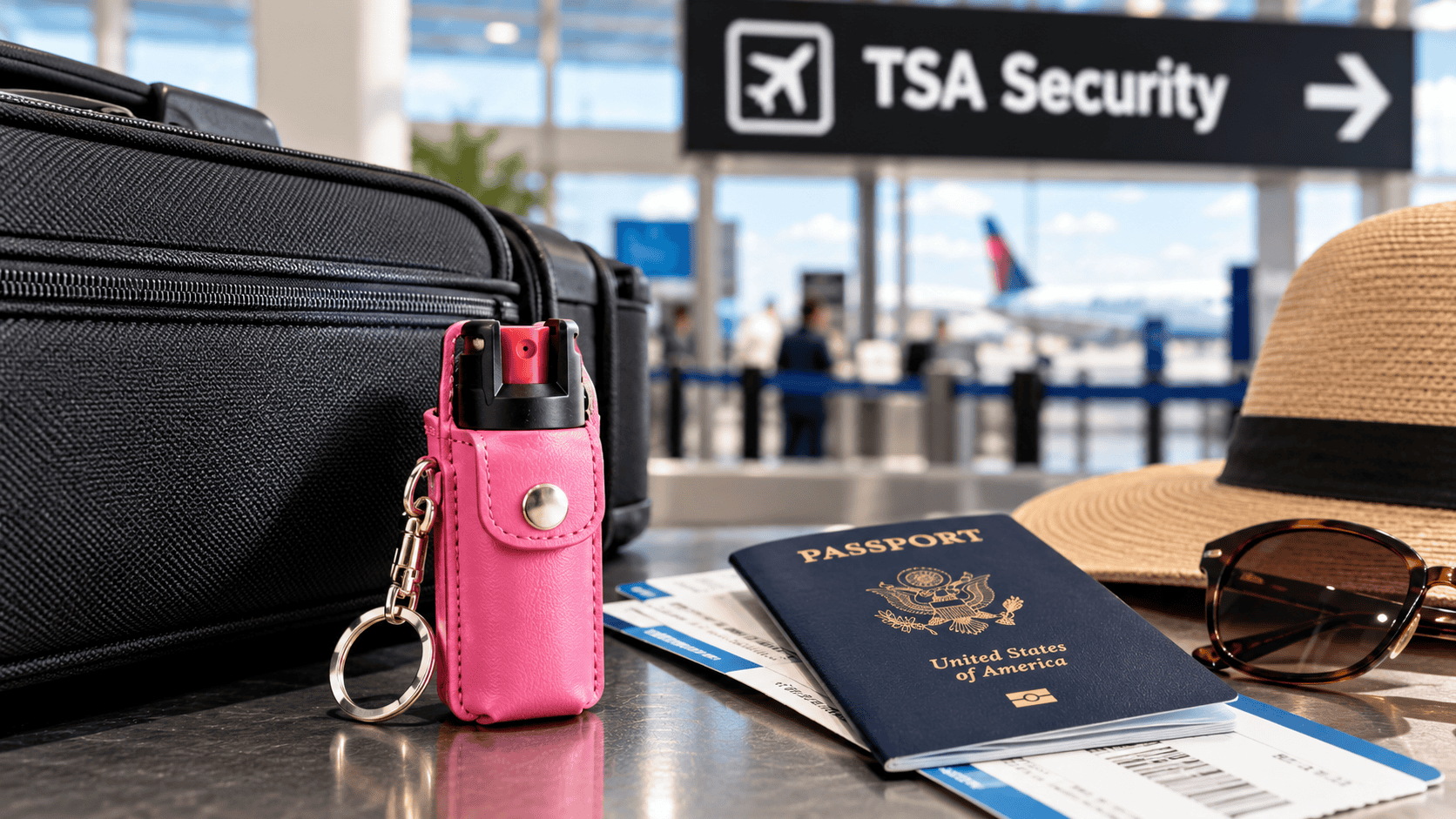
Can you bring pepper spray on an airplane? Not in your carry-on bag. For domestic flights within the United States, federal aviation regulations provide a limited exception allowing certain small self-defense sprays in checked baggage. However, individual airlines can prohibit them entirely, and international aviation rules are more restrictive.
Before packing pepper spray for a flight, it’s important to understand the difference between TSA security rules, FAA hazardous-materials regulations, airline policies, and the laws at your destination. This guide explains those distinctions so you can make informed travel decisions.
No. Pepper spray, MACE, and similar self-defense sprays are prohibited in carry-on baggage and cannot be taken through TSA passenger screening checkpoints.
The familiar TSA 3-1-1 liquids rule does not create an exception for pepper spray. Even a small keychain-sized canister is prohibited in carry-on luggage.
Checked baggage is different. Federal regulations provide a limited exception for qualifying self-defense sprays, but only when all applicable requirements are satisfied and the airline accepts the item.
Under the FAA’s domestic checked-baggage exception, a passenger may transport one qualifying self-defense spray containing no more than 4 fluid ounces (118 milliliters), provided the container has a positive safety mechanism that prevents accidental discharge.
The FAA also prohibits self-defense sprays containing more than 2% by mass of CS or CN tear gas. The product must meet the applicable regulatory definition and requirements for a self-defense spray.
Importantly, a recessed spray button alone is not considered an adequate safety mechanism. The FAA describes an additional protective feature, such as a flip-up cap, as an example of an acceptable safeguard.
These are federal maximum allowances, not a guarantee that a particular product will be accepted. An airline may apply a stricter policy.
Official reference: FAA PackSafe: Sprays and Repellents.
| Travel situation | General rule |
|---|---|
| Carry-on baggage | Not permitted |
| Checked baggage on qualifying U.S. domestic flights | Potentially permitted under the federal exception, subject to airline policy |
| Maximum quantity | One qualifying container per passenger |
| Maximum container capacity | 4 fluid ounces (118 mL) |
| Accidental-discharge protection | Positive safety mechanism required |
| CS or CN tear gas | More than 2% by mass is prohibited |
| International air travel | Prohibited in carry-on and checked baggage under international aviation rules |
| Individual airline restrictions | May be stricter than the federal exception |
Because transportation regulations and airline policies can change, verify the current requirements before every trip.
Yes. This is one of the most important distinctions for travelers. The FAA establishes federal transportation requirements, but airlines can adopt stricter baggage policies.
Southwest Airlines prohibits self-defense sprays, including pepper spray and MACE, on a passenger’s person and in both carry-on and checked baggage. A container that meets the FAA’s size and safety requirements is still prohibited under Southwest’s policy.
See the Southwest Airlines self-defense spray policy.
Delta Air Lines lists MACE, pepper spray, and bear deterrent among items that are not allowed on its flights. Travelers should not assume that the federal checked-baggage exception overrides Delta’s restrictions.
See Delta’s prohibited and restricted items guidance.
For other airlines, check the carrier’s current hazardous-materials and restricted-baggage policies directly. Do not rely solely on a general TSA packing summary or an older travel article.
International aviation regulations prohibit self-defense sprays in both carry-on and checked baggage. The FAA specifically identifies this restriction in its PackSafe guidance.
Travelers should not assume that a product accepted under a limited U.S. domestic exception will be permitted on an international itinerary, including connecting flights.
Separate from airline transportation rules, countries may also restrict the possession, importation, or use of pepper spray. Research the laws of your destination before considering any personal safety product for international travel.
If you are traveling on a qualifying domestic itinerary with an airline that accepts self-defense sprays, review these points before packing:
Protect the container from damage and unintended pressure during transport. If you cannot confirm that the product and itinerary satisfy all requirements, leave the spray at home rather than risk confiscation or travel disruption.
No. Small size alone does not establish compliance. A compact keychain spray might meet the federal capacity limit while failing another requirement, such as the positive safety mechanism or the airline’s own baggage policy.
Likewise, a product described as a personal safety spray or travel-size dispenser should not automatically be considered approved for air transportation. Product labeling and marketing terms are not substitutes for official regulations.
If you’re comparing everyday personal safety products for use at your destination, our user-friendly pepper spray collection provides information about available styles and features. Always evaluate air-travel eligibility separately.
Travelers who cannot bring pepper spray may want to consider non-spray personal safety habits and accessories. A personal alarm, a small conventional flashlight, and a charged mobile phone can support everyday awareness without relying on a chemical self-defense spray.
However, travelers should still check screening and airline rules for any electronic or specialized device. An item should not be described as universally permitted without verifying its specific features and applicable restrictions.
Simple planning also matters: arranging reliable transportation, keeping important contacts accessible, and staying aware of your surroundings can be useful parts of a travel safety routine.
No. Pepper spray is prohibited in carry-on baggage, regardless of whether the container is smaller than the usual liquids limit.
Possibly, on a qualifying U.S. domestic flight. Federal regulations provide a limited exception for one self-defense spray of no more than 4 fluid ounces, with a positive safety mechanism and compliant ingredients. Your airline must also permit it.
No. Southwest Airlines prohibits self-defense sprays in both checked and carry-on baggage.
No. International aviation regulations prohibit self-defense sprays in both carry-on and checked baggage.
No. A positive safety mechanism is only one requirement. Container capacity, quantity, ingredients, flight type, and airline restrictions must also be considered.
The answer to whether you can bring pepper spray on an airplane depends on where it is packed, the type of flight, the product’s specifications, and the airline’s rules.
For U.S. domestic flights, a narrow federal exception exists for qualifying self-defense sprays in checked baggage. That exception does not apply to carry-on bags, does not override stricter airline policies, and should not be assumed to apply to international travel.
Before your next trip, check the FAA’s current PackSafe guidance and your airline’s baggage restrictions. A few minutes of verification can help prevent avoidable problems at the airport.
This article provides general regulatory and legal information, not individualized legal advice. Transportation requirements, airline policies, and local laws can change.







We use cookies to improve your experience on our site. By using our site, you consent to cookies.
Manage your cookie preferences below:
Essential cookies enable basic functions and are necessary for the proper function of the website.
These cookies are needed for adding comments on this website.
Statistics cookies collect information anonymously. This information helps us understand how visitors use our website.
Google Analytics is a powerful tool that tracks and analyzes website traffic for informed marketing decisions.
Service URL: business.safety.google (opens in a new window)
