

U.S. Legal in Most States • Discreet Shipping • Real-World Protection • No Permits Required in Most Areas
U.S. Legal in Most States • Discreet Shipping • Real-World Protection • No Permits Required in Most Areas

The most practical door alarms for women living alone combine a minimum 120dB output, magnetic or vibration sensor technology, and simple installation that requires no tools and leaves no damage — critical for renters. The best setups don’t rely on a single device at the front door. They layer coverage across every realistic entry point: front door, sliding glass panels, ground-floor windows, and garage access. That complete-coverage approach is what separates a real security system from a false sense of one.
Living alone carries a particular set of security considerations that generic “home alarm” buying guides rarely address with appropriate seriousness. The question isn’t simply which alarm is loudest. It’s which combination of devices, installed with precision at the right locations, creates a layered perimeter that gives you meaningful advance notice — and enough time to act. This guide is built around that standard.
Reliability in a door alarm is defined by three performance variables: decibel output, sensor mechanism, and activation speed. A 120dB alarm is the accepted minimum for effective deterrence — that output level is comparable to a jet engine at 100 feet and is physically uncomfortable to anyone within close range. Alarms rated below 100dB are insufficient. The best units in this category reach 125–130dB, which carries through walls and floors and eliminates the “maybe no one heard it” scenario.
Sensor mechanism determines false-alarm rate and detection accuracy. Magnetic contact sensors — the most common type — trigger when the two-piece unit separates beyond a calibrated gap, typically 20–30mm. These are highly reliable and appropriate for hinged doors and most windows. Vibration sensors, often integrated into the same unit, detect the impact signature of forceful entry before a door or window fully opens. That split-second earlier warning matters.
Activation speed — the time between trigger event and full-volume output — should be under one second. Delayed-activation units exist for convenience (a 15–30 second entry delay lets you disarm before the alarm sounds), but for a woman living alone, an immediately-armed perimeter alarm with no delay is the more disciplined choice for overnight and away-from-home use.
Most people install an alarm on the front door and consider the job done. That’s incomplete. A thorough perimeter assessment identifies six primary vulnerability categories: the primary entry door, secondary exterior doors (back door, side door), sliding glass doors and patio panels, ground-floor and basement windows, garage-to-home access doors, and any shared-building access points in apartment or condo settings.
Sliding glass doors deserve specific attention. They’re the most common secondary entry point targeted in residential break-ins, and standard magnetic contact alarms don’t mount cleanly on most sliding frames without an adapter or specialized unit. Vibration-activated sensors designed for glass panels address this gap directly. A quality glass-break vibration alarm mounted to the glass itself — not the frame — detects forceful impact with significantly greater sensitivity than frame-mounted alternatives.
Ground-floor windows are frequently overlooked entirely. Window alarms using the same magnetic two-piece sensor design as door units install in under two minutes with the included adhesive, require no tools, and function identically. A thorough setup for a one-bedroom apartment typically requires four to six individual sensor units covering all realistic entry points — not one or two.
If you live in an apartment building, consider the door and window alarm options built specifically for renters — they’re designed around no-damage installation, portability between units, and the access-point realities of shared-building living.
The 120dB threshold is the professional standard for deterrence-grade alarm output. To put that in physiological terms: sustained exposure above 110dB causes discomfort within seconds; 120dB triggers an involuntary startle and pain response. At 130dB — the output rating on the strongest units available in this category — the acoustic effect on an intruder within 10 feet is genuinely disorienting.
Beyond deterrence, decibel output determines notification range. A 120dB alarm is audible through interior walls at 50 feet under normal conditions; in a quiet nighttime environment, effective range extends significantly farther. For a woman living alone, notification range matters because the alarm’s secondary function — alerting neighbors or nearby individuals — is as valuable as its primary deterrent effect.
Battery life intersects with reliability here. A 130dB alarm drawing high current from two AAA batteries under continuous activation will drain significantly faster than a 120dB unit. The better units in this category use efficient piezo transducer technology that maintains rated output without excessive battery drain. Alarms with a low-battery indicator LED eliminate the risk of running an unknowingly depleted unit on your perimeter — that indicator is a detail worth specifically checking before purchase.
The difference is use-case specificity. Standard home security products are often designed around a household with multiple occupants — entry delays to avoid triggering alarms before a partner can disarm, centralized control panels, professional monitoring subscriptions. For a single-occupancy home, those features add complexity and cost without proportional security benefit.
The better framework for a woman living alone is a standalone sensor network — individual alarm units at each entry point, each independently armed, each capable of triggering at full volume without any central system, subscription, or WiFi dependency. Standalone alarms cannot be disabled by cutting a power line or jamming a wireless signal. They operate on batteries, independently, and they work when the power is out.
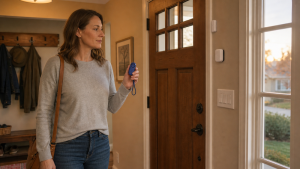
The secondary layer worth adding to that standalone network is a personal alarm carried on your person — a separate device with its own 120–130dB output that functions regardless of where you are in the home. A high-output personal alarm for women bridges the gap between a triggered perimeter alarm and your physical location — particularly relevant in a larger home or multi-floor layout where you may not hear a distant sensor immediately.
Adhesive-mounted two-piece magnetic sensors are the standard answer for damage-free installation, and the quality of that adhesive determines long-term performance. Industrial-grade 3M VHB tape backing — the type used in commercial applications — holds reliably on painted wood, metal, and PVC door frames through years of thermal cycling. Budget units use lower-grade adhesive that fails under temperature swings or on lightly textured surfaces.
Proper surface preparation matters more than most installation guides acknowledge. Clean the mounting surface with isopropyl alcohol, allow it to dry fully, then apply firm pressure to the sensor unit for 30 seconds. Adhesive-mounted sensors installed without surface prep on dusty or oil-residue surfaces will fail within weeks — not because the alarm itself is defective, but because the mounting failed.
For doors with significant frame play — older apartment doors that rattle in the frame, for example — a vibration sensor rather than a pure magnetic contact sensor is the more reliable choice. Magnetic sensors trigger on gap separation; if a door with loose tolerances flexes in wind or from hallway traffic, a magnetic sensor can false-trigger. A vibration sensor calibrated to the impact signature of forced entry avoids that problem entirely.
Beyond the door itself, this detailed breakdown of layered home security with door and window alarms walks through exactly how to sequence your coverage priorities for maximum overlap with minimum redundancy.
A door alarm is the outermost layer of a personal security framework — the early warning element. Its function is to give you time and information: time to move, time to call for help, time to retrieve a secondary defensive tool. Treated as a standalone solution, it’s insufficient. Treated as the first layer of a deliberately constructed system, it’s indispensable.
The next layer inward is typically a personal alarm or defensive tool accessible from your sleeping area. A 130dB personal alarm on your nightstand — immediately reachable, requiring zero preparation to deploy — is a direct complement to a perimeter sensor network. If a door alarm triggers at 2:00 AM, you want a secondary alarm in hand within seconds, not minutes.
For a full picture of how door alarms fit alongside other tools in a practical everyday self-defense framework, the guide to everyday self-defense tools for women covers the complete spectrum — what belongs in your home, what belongs on your person, and how to assess your actual risk profile rather than buying reactively.
A complete setup typically requires four to seven individual sensor units for a standard apartment or small home: one per exterior door, one per sliding glass panel, and one per ground-floor window. Start with primary entry points and expand from there. A single front-door alarm leaves significant gaps in your perimeter coverage — coverage that a thorough intruder assessment would exploit.
Yes, but the installation approach differs from a hinged door. Standard two-piece magnetic sensors can mount on sliding door frames if the gap between the door and frame is consistent when closed. For better reliability, a vibration-activated glass sensor mounted directly to the glass panel detects forceful impact with greater sensitivity and works regardless of frame tolerances or frame material.
A door stop alarm wedges under an inward-opening door and triggers a piezo alarm when pressure is applied from the outside — typically 100–120dB output. It’s a solid secondary layer for hotel rooms or rental units where you can’t mount sensors. A standard door alarm sensor triggers on magnetic separation or vibration. For a permanent home setup, mounted sensors are more reliable; door stop alarms are the superior portable travel option.
Standalone battery-operated door alarms function entirely independently of your home’s electrical system. Power outages do not affect them. This is a significant advantage over hardwired security systems that require a backup battery or professional monitoring to maintain function during outages. Confirm your alarm units use standard replaceable batteries — AA or AAA — and keep spares on hand.
120dB is approximately equivalent to a live rock concert at close range or a chainsaw at arm’s length. It exceeds the threshold where sustained exposure causes immediate discomfort and triggers an involuntary startle response. At that output level, an intruder who has activated your alarm is dealing with a physiologically disruptive sound while simultaneously announcing their presence to everyone within a significant radius.
Adhesive-mounted standalone door alarm sensors leave no permanent damage and are considered personal property rather than a structural modification in most lease frameworks. That said, lease terms vary — review your specific agreement. Damage-free adhesive installation is the standard precisely because it eliminates this friction point. For a full breakdown of alarm options built around renter-specific constraints, see the guide to door and window alarms for renters and apartments.
Do not immediately investigate the source. Move to a secure interior room, take your phone and any personal alarm or defensive tool with you, and call 911. A triggered perimeter alarm at night should be treated as a confirmed intrusion until law enforcement clears the premises. Your position behind a locked interior door with a 130dB personal alarm in hand is tactically superior to moving toward the source of the alert.
Door alarms are the early warning layer — not a complete security solution. They excel at detection and deterrence. A comprehensive setup pairs perimeter sensor alarms with a personal alarm carried on your person, reinforced door hardware (quality deadbolts and strike plates), and awareness of your surroundings outside the home. Each layer addresses a gap the others don’t cover. Relying on any single layer is the mistake most people make.
A door alarm network built to this standard — complete perimeter coverage, 120dB minimum output, quality adhesive mounting, and integration with a personal alarm — is the mark of a security setup that was assembled with genuine intention rather than purchased reactively after a scare. The difference between the two approaches shows up at 2:00 AM, when the decisions were already made. Build the system now, install it completely, and operate from a position of preparation rather than reaction.
Browse the full selection of door and window alarm options at Nittany Self Defense to identify the units that close every gap in your specific floor plan — and pair them with a personal alarm rated for the demands of living alone.






We use cookies to improve your experience on our site. By using our site, you consent to cookies.
Manage your cookie preferences below:
Essential cookies enable basic functions and are necessary for the proper function of the website.
These cookies are needed for adding comments on this website.
Statistics cookies collect information anonymously. This information helps us understand how visitors use our website.
Google Analytics is a powerful tool that tracks and analyzes website traffic for informed marketing decisions.
Service URL: business.safety.google (opens in a new window)