
U.S. Legal in Most States • Discreet Shipping • Real-World Protection • No Permits Required in Most Areas
U.S. Legal in Most States • Discreet Shipping • Real-World Protection • No Permits Required in Most Areas
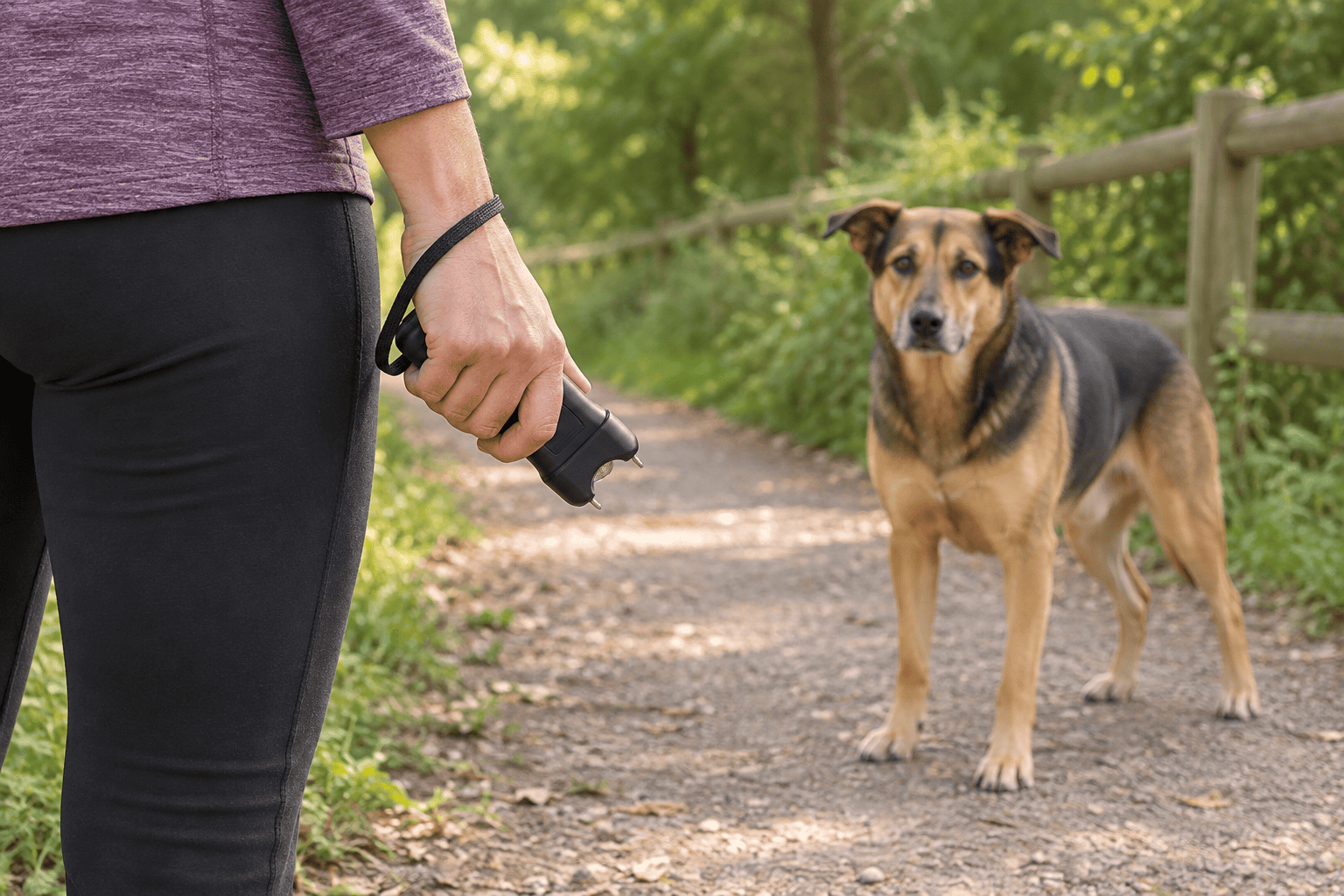
What about stun guns for animal control? Quick Answer: Stun guns sometimes come up in discussions about protection from aggressive animals, but an ordinary contact stun gun has an important limitation: it generally requires you to be extremely close to the animal. For many encounters, creating distance and using a purpose-designed animal deterrent may be more practical than relying on a contact electrical device.
It’s also important to distinguish ordinary consumer stun guns from specialized conducted-energy devices that may be used by trained professionals. They aren’t necessarily the same tools, and professional wildlife-management applications shouldn’t be treated as instructions for handling an animal encounter yourself.
A traditional stun gun is primarily a close-contact personal safety device. That creates an obvious concern around an aggressive dog or other animal: using the electrical function generally means getting within direct-contact distance.
Animal behavior can also be unpredictable. You shouldn’t assume that an animal will respond to the sight, sound, or electrical operation of a stun gun in a particular way.
For those reasons, a stun gun shouldn’t be treated as a guaranteed animal-control solution. The circumstances, animal, environment, available escape routes, and other deterrent options all matter.
One of the most important distinctions is between an ordinary stun gun and a device designed to deploy probes from a distance.
Traditional stun guns generally require direct contact. That limitation matters in human self-defense situations, and it may matter even more when you’re dealing with an unfamiliar or aggressive animal.
Getting closer to an animal simply so a contact device can reach it may increase your exposure to bites, scratches, or other injuries. Whenever circumstances allow, maintaining distance and moving toward a safer location should take priority over approaching an animal.
Some discussions of electronic devices used in professional animal control or wildlife management involve conducted-energy devices capable of deploying probes. Those examples shouldn’t be confused with ordinary consumer contact stun guns.
TASER is a brand name, and certain TASER devices operate differently from traditional stun guns. Professional agencies may also have specialized equipment, policies, training, veterinary guidance, or legal authority that doesn’t apply to an ordinary consumer.
That distinction is particularly important when reading accounts of electronic devices being used during wildlife rescues or professional animal-control operations. A specialized application by trained personnel doesn’t establish that a consumer stun gun is appropriate for handling wildlife.
Activating some stun guns produces a noticeable electrical crackling sound. An animal may notice or react to an unfamiliar sound, but its response shouldn’t be considered predictable.
One animal might retreat, another might show little reaction, and another could become more agitated. Avoid relying on sound alone as a dependable animal deterrent unless the product was specifically designed and supported by its manufacturer for that purpose.
An electronic dog repeller is a different type of product. Rather than requiring electrical contact with the animal, these devices are designed to emit sound intended to discourage or interrupt unwanted behavior from a distance.
That doesn’t mean an electronic dog repeller will work with every dog or in every situation. Animal temperament, hearing, distance, distractions, and other conditions can affect how an animal responds.
But for someone specifically concerned about unwanted dog encounters, comparing a purpose-designed dog repeller with a close-contact stun gun makes more sense than assuming the two products serve exactly the same function.
Dog pepper sprays and similar animal-repellent products are designed specifically for animal encounters and allow some distance between the user and the animal. That is an important practical difference from a traditional contact stun gun.
Sprays have limitations of their own. Range, spray pattern, wind, environmental conditions, product condition, and the individual animal can all affect an encounter. A spray canister also has a finite amount of product and should be inspected and replaced according to the manufacturer’s recommendations.
If your primary concern is an aggressive or approaching dog, a product specifically intended for dog deterrence deserves consideration alongside more general personal safety devices.
A consumer contact stun gun shouldn’t be treated as a substitute for a wildlife deterrent specifically designed for the species and environment you may encounter.
For example, bear spray is designed specifically as a bear deterrent and provides distance that a contact stun gun does not. Anyone entering bear country should learn current guidance for the area, understand how to store and carry the appropriate deterrent, and follow recommendations from wildlife and land-management authorities.
The same general principle applies to other wildlife: identify the animals you’re reasonably likely to encounter and learn the recommended prevention and response practices for those species rather than assuming one personal safety device is appropriate for everything.
Personal safety around animals begins before a deterrent device becomes necessary. Give unfamiliar animals space, avoid intentionally approaching wildlife, and don’t place yourself between an animal and its young, food, territory, or apparent escape route.
If an animal is behaving aggressively, circumstances permitting, increasing distance and moving toward a secure location may give you more options than moving closer in order to use a contact device.
For recurring problems involving loose domestic animals, nuisance wildlife, or animals on your property, contacting the appropriate animal-control or wildlife authority may be more appropriate than attempting to physically control the animal yourself.
People who regularly walk or jog may be particularly concerned about unexpected encounters with loose dogs. In that situation, portability matters, but so does choosing a product that actually fits the problem you’re preparing for.
Consider how much distance a particular deterrent allows, whether it is designed for animals, how easily it can be carried during normal activity, and what its manufacturer recommends. A personal alarm, dog repeller, animal-repellent spray, or other safety product may serve a different purpose from a traditional stun gun.
No single product eliminates risk, so situational awareness and avoiding known problem areas when practical remain useful parts of a broader safety plan.
Laws governing stun guns, animal repellents, wildlife interactions, and defensive force can vary by jurisdiction. The fact that a particular device is legal to possess doesn’t automatically mean every use of that device against an animal would be lawful.
Domestic animals and wildlife may also be covered by different laws. Professional animal-control officers and wildlife personnel can operate under regulations, training requirements, and agency policies that don’t apply to members of the public.
Check current state and local requirements before carrying or using any personal safety or animal-deterrent product. When dealing with wildlife, guidance from the appropriate wildlife or land-management authority can also help you choose methods suited to the animals in that area.
Instead of asking whether a stun gun is simply “good for animals,” start with the type of encounter you’re actually preparing for.
A traditional stun gun is a close-contact electrical device, which can be a significant limitation around an aggressive animal. Professional animal-control applications may involve different equipment, training, policies, and legal authority and shouldn’t automatically be generalized to consumer stun guns.
A dog may notice or react to the electrical crackling sound of some stun guns, but animal responses aren’t predictable. The sound shouldn’t be treated as a guaranteed dog deterrent.
No. An electronic dog repeller is designed to emit sound intended to discourage or interrupt unwanted behavior from a distance. A traditional stun gun generally requires direct physical contact for its electrical function.
Animal-repellent sprays designed for dogs are another option to consider and provide some distance between the user and animal. They have limitations of their own, so follow the manufacturer’s instructions and check applicable laws.
A consumer contact stun gun shouldn’t be treated as a substitute for a deterrent specifically designed for bear encounters. Follow current guidance from wildlife authorities for the area you are visiting and learn how to carry and use recommended bear-deterrent products.
Laws vary by jurisdiction and may distinguish between possession of a device and how it may lawfully be used. Domestic animals, wildlife, professional animal control, and defensive situations may also be governed by different rules. Check current state and local requirements.
Stun guns and animal control shouldn’t be treated as a simple one-size-fits-all combination. Traditional stun guns generally require close contact, while many animal encounters are better approached by maintaining distance and using prevention or deterrent methods suited to the particular animal.
If animals are your primary concern, compare purpose-designed options such as dog repellents, electronic dog repellers, or wildlife-specific deterrents rather than assuming a general personal safety device is automatically the best tool.
Understanding the animal, the environment, the device’s limitations, and the applicable laws is more useful than relying on broad claims about what any single product can do.







We use cookies to improve your experience on our site. By using our site, you consent to cookies.
Manage your cookie preferences below:
Essential cookies enable basic functions and are necessary for the proper function of the website.
These cookies are needed for adding comments on this website.
Statistics cookies collect information anonymously. This information helps us understand how visitors use our website.
Google Analytics is a powerful tool that tracks and analyzes website traffic for informed marketing decisions.
Service URL: business.safety.google (opens in a new window)