
U.S. Legal in Most States • Discreet Shipping • Real-World Protection • No Permits Required in Most Areas
U.S. Legal in Most States • Discreet Shipping • Real-World Protection • No Permits Required in Most Areas

Stun guns on college campuses occupy a legally complicated space that depends on your state’s laws, your school’s specific policies, and sometimes even which building you’re standing in — and getting it wrong can mean disciplinary action, criminal charges, or simply being caught defenseless because you left your protection at home out of uncertainty. For students, parents, and campus workers who take personal safety seriously, understanding exactly where stun guns are permitted — and where they absolutely are not — is the foundation of every smart self-defense decision you’ll make in those four years.
There is something deeply personal about this question. Behind every search for “can I carry a stun gun on campus” is a real person — a first-year student moving into a residence hall three states from home, a parent dropping off their daughter and lying awake wondering if she’ll be safe, a commuter student crossing a dimly lit parking structure at 11 p.m. after a night class. The legal landscape matters because safety matters, and this guide is written for those people — the ones who want to do things right and stay protected at the same time.
Federal law does not specifically ban stun guns from college campuses. Unlike firearms, which are governed by strict federal regulations and the Gun-Free School Zones Act (which applies to K-12 schools), stun guns and conducted energy devices are not addressed at the federal level in a way that creates a blanket prohibition on campuses. This is genuinely important to understand, because it means the real legal framework is built from two layers below federal law: state statutes and individual institutional policy.
What federal law does establish is the framework within which states and institutions operate. Public universities, as recipients of federal funding, have their own obligations and governance structures — but those structures do not automatically prohibit stun guns. The decision lives at the state and campus level. This is why a student in one state may carry legally while a student at a neighboring state’s university faces a misdemeanor charge for the identical device.
The practical takeaway: federal law is not your obstacle here. State law and campus policy are where you need to focus your research — and where we’ll spend the rest of this guide.
As of current legislative sessions, the majority of U.S. states permit stun gun ownership for adults, but a meaningful subset restricts or outright bans carry on college and university property — regardless of whether those campuses are public or private. States including Hawaii, Rhode Island, and Michigan have historically imposed stricter stun gun laws at the state level. Several other states permit stun guns generally but grant universities broad authority to ban them on campus grounds.
A growing number of states have moved in the opposite direction. Texas, for example, passed campus carry legislation that opened the door for certain weapons on public university campuses, and several other states have debated or passed similar measures specifically addressing personal defense tools. Some states explicitly carve out stun guns as a permitted defense tool even where firearms are restricted.
The most critical thing to understand is that state law sets the floor, not the ceiling. Even in states where stun guns are broadly legal, your university may still prohibit them on campus property. Before you carry anything, check your state’s stun gun statutes and your school’s student conduct code — both. Our dedicated post on whether stun guns are legal and what you need to know walks through the state-by-state framework in detail and is worth bookmarking alongside this one.
Yes — and most do. This is the part that surprises people the most, and it’s the part that matters most practically. Even in states where stun guns are perfectly legal for adults to own and carry, public and private universities routinely ban them from campus grounds through their student conduct codes, residence hall policies, and weapons policies. These institutional bans carry real consequences: violation typically results in disciplinary action, suspension, or expulsion, and in some cases criminal trespass charges if you remain on property after being warned.
Private universities operate with particularly broad authority here. Because they are private institutions, their policies function somewhat like private property rules — they can prohibit almost anything on their grounds regardless of state law permitting it. Public universities face slightly more legal scrutiny, particularly in states where stun gun carry is an established right, but the majority still maintain weapons-free policies that include stun guns.
The important nuance is that campus bans typically apply to campus property — not to off-campus apartments, commuter routes, or surrounding neighborhoods. Students who live off campus and commute may find that they can legally carry a stun gun for their commute but need to secure it before arriving on campus grounds. For commuter students and those living nearby, this distinction can meaningfully expand your legal protection options. If you walk or run in your campus neighborhood, take a look at the options we carry specifically designed for stun guns for walkers and stun guns for runners — tools built for exactly the kind of route that takes you through areas a campus policy doesn’t govern.
Campus bans are rarely uniform in their application across every square foot of university property. Understanding the geography of campus weapons policy helps you navigate your options intelligently. Residence halls are almost universally off-limits — residential life policies are typically the strictest, and violations there carry the sharpest consequences. Academic buildings, athletic facilities, and libraries follow closely behind in typical policy language.
Open-air spaces — public plazas, outdoor walkways, campus edges that blur into surrounding public streets — represent legal gray zones that vary by institution and state. Some campus policies specifically extend to all university-controlled property, including outdoor spaces. Others focus language on buildings. Knowing exactly what your campus policy says, word for word, matters here.
Campus housing operated off-site or in university-adjacent neighborhoods occasionally falls under different rules. Graduate student housing, university-affiliated apartments several blocks from the main campus, and faculty residential facilities each carry their own policy language. If your living situation is off-campus housing that simply has a university affiliation, verify whether campus weapons policy extends there before assuming either direction.
Campus security offices — and even campus security personnel themselves — operate under institutional weapons policies. If you’re interested in how professional security practitioners approach stun gun carry and selection, our stun guns for security guards category covers the professional-grade tools in that space.
This is where the conversation gets genuinely hopeful — because campus weapons bans, as frustrating as they are for safety-minded students, don’t eliminate your ability to protect yourself. They require you to think more strategically about what tools fall within the rules, and there are meaningful options that do.
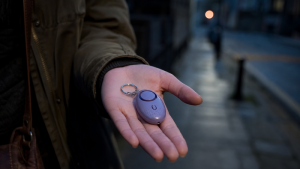
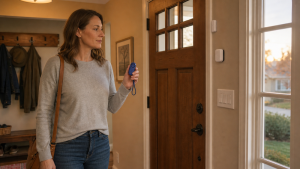
Personal alarms are legal on virtually every campus in the country. A 130dB personal alarm draws immediate attention, disorients an attacker, and requires no legal clearance whatsoever. These belong on every student’s keychain regardless of whether they carry anything else. Pepper spray is explicitly legal in many campus policies — always check yours specifically, but many schools that ban stun guns permit pepper spray for students who are legal adults. Brands like Mace and WildFire make compact formulations designed for exactly this kind of everyday carry.
Beyond specific tools, situational awareness is the self-defense skill that carries no weight limit, costs nothing, and is never prohibited. Understanding your campus layout, identifying well-lit routes, using campus escort services, and trusting your instincts in uncomfortable situations are layered protections that work with any legal carry setup you build around them.
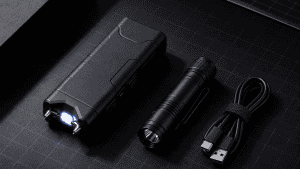
For students who live off campus and commute, legal carry during the commute is worth thinking through carefully. The Streetwise and Runt lines of compact stun guns, for example, are designed for discreet everyday carry — tools that can travel with you legally during your commute and be secured before you arrive on campus grounds. Understanding reliability and charge life matters for any tool you depend on; our post on how long rechargeable stun guns actually stay charged gives you the field-tested data you need before committing to a device you’ll rely on daily.
Start with your student handbook and conduct code — these are publicly available on virtually every university’s website and are searchable. Look for the weapons policy section, which will typically include an explicit list of prohibited items. The language matters: some policies say “electronic control devices,” some say “stun guns,” some say “conducted energy weapons.” Read carefully and take note of whether the prohibition covers carry, possession, storage in your room, or all of the above.
If the policy language is ambiguous — and it often is — email your campus security office or student affairs office with a direct question. Get the answer in writing. This protects you and gives you a clear record of what you were told. Campus police departments are also typically willing to answer these questions directly and are not going to flag you for asking — they would rather you ask than carry something prohibited out of a misunderstanding.
State laws can be verified through your state legislature’s official website, your state attorney general’s FAQ resources, or through legal aid offices that many universities offer free of charge to enrolled students. Do not rely on Reddit, social media posts, or anecdotal information from other students. Stun gun laws change — sometimes significantly — with legislative sessions, and information that was accurate two years ago may not reflect current law.
In most cases, no. Campus weapons policies typically prohibit possession on campus property, which includes residence halls. Keeping a stun gun in your dorm room generally violates the same policy as carrying it across campus, and residential life staff may conduct room inspections. Check your specific school’s policy language — but expect that possession in campus housing is prohibited at most institutions regardless of whether you carry it.
Legally and policy-wise, TASER devices are typically treated the same as or more restrictively than traditional stun guns on campus. TASER is a brand name for a category of conducted energy weapon — one that can project electrodes at range. Campus policies that ban “stun guns” or “electronic control devices” almost always include TASER devices in that prohibition. TASERs designed for civilian use are also more expensive and subject to stricter state laws in several jurisdictions.
Consequences vary by institution and severity. At minimum, expect confiscation and a student conduct referral that could result in probation, suspension, or expulsion depending on your school’s disciplinary matrix. In some states, carrying a prohibited weapon on campus property constitutes a criminal offense — misdemeanor or felony depending on state law. Never assume a first offense means no consequences. The institutional and legal exposure is real and worth taking seriously.
Not always. Many campus policies that ban stun guns explicitly permit or do not mention pepper spray, treating them as distinct categories. Pepper spray is legal for adults in the majority of U.S. states and falls outside the “electronic weapon” language used in many campus conduct codes. That said, some schools do prohibit all chemical sprays as well. Read your specific policy — do not assume pepper spray is permitted simply because stun guns are banned.
Yes. Campus law enforcement and authorized security personnel operate under different legal and institutional frameworks than students. Campus police — who are typically sworn officers in most states — carry stun guns and other defensive tools as part of their professional responsibilities. Institutional weapons policies that ban student carry do not apply to authorized law enforcement acting in official capacity.
Potentially, yes — but with important caveats. If your state law permits stun gun carry for adults and your commute takes you through public property, you may be able to carry legally during transit. The restriction kicks in when you arrive on campus-controlled property. Practically, this means you need a secure plan for what happens to your device before you enter campus grounds. A locked vehicle compartment is one approach many commuter students use.
Campus weapons policies apply to anyone on campus property — enrolled student, visiting student, or general public. Your enrollment status as a primarily online student does not create an exemption from the institutional weapons policy when you are physically present on campus grounds. The same rules apply whether you are there every day or once a semester.
Start with your state legislature’s official website, where statutes are published and searchable. Your state attorney general’s office often publishes summaries of weapons laws for public reference. Campus legal aid services — available free to enrolled students at many universities — can help you interpret state law as it applies to your situation. Avoid relying on social media or informal sources; laws change with legislative sessions and vary by locality within states.
Campus safety is not a problem that resolves itself. Every student who walks to a night class, every parent who sends a child across the country to school, every commuter who crosses a parking deck alone after dark — they deserve clear answers and real tools. The legal landscape around stun guns on campus is genuinely complicated, but it is navigable. Know your state law. Know your campus policy. Know what options remain available to you within those rules — and build your personal safety plan around that knowledge rather than around guesswork.
If you’re in the process of building that plan and want to understand the full range of legal carry options available to you on and off campus, browse the personal defense tools at Nittany Self Defense — or explore our stun guns for home defense if your immediate priority is protecting your off-campus living space. Safety isn’t a single decision — it’s a set of informed, layered choices. Start with the best information you can get, and go from there.






We use cookies to improve your experience on our site. By using our site, you consent to cookies.
Manage your cookie preferences below:
Essential cookies enable basic functions and are necessary for the proper function of the website.
These cookies are needed for adding comments on this website.
Statistics cookies collect information anonymously. This information helps us understand how visitors use our website.
Google Analytics is a powerful tool that tracks and analyzes website traffic for informed marketing decisions.
Service URL: business.safety.google (opens in a new window)