

U.S. Legal in Most States • Discreet Shipping • Real-World Protection • No Permits Required in Most Areas
U.S. Legal in Most States • Discreet Shipping • Real-World Protection • No Permits Required in Most Areas
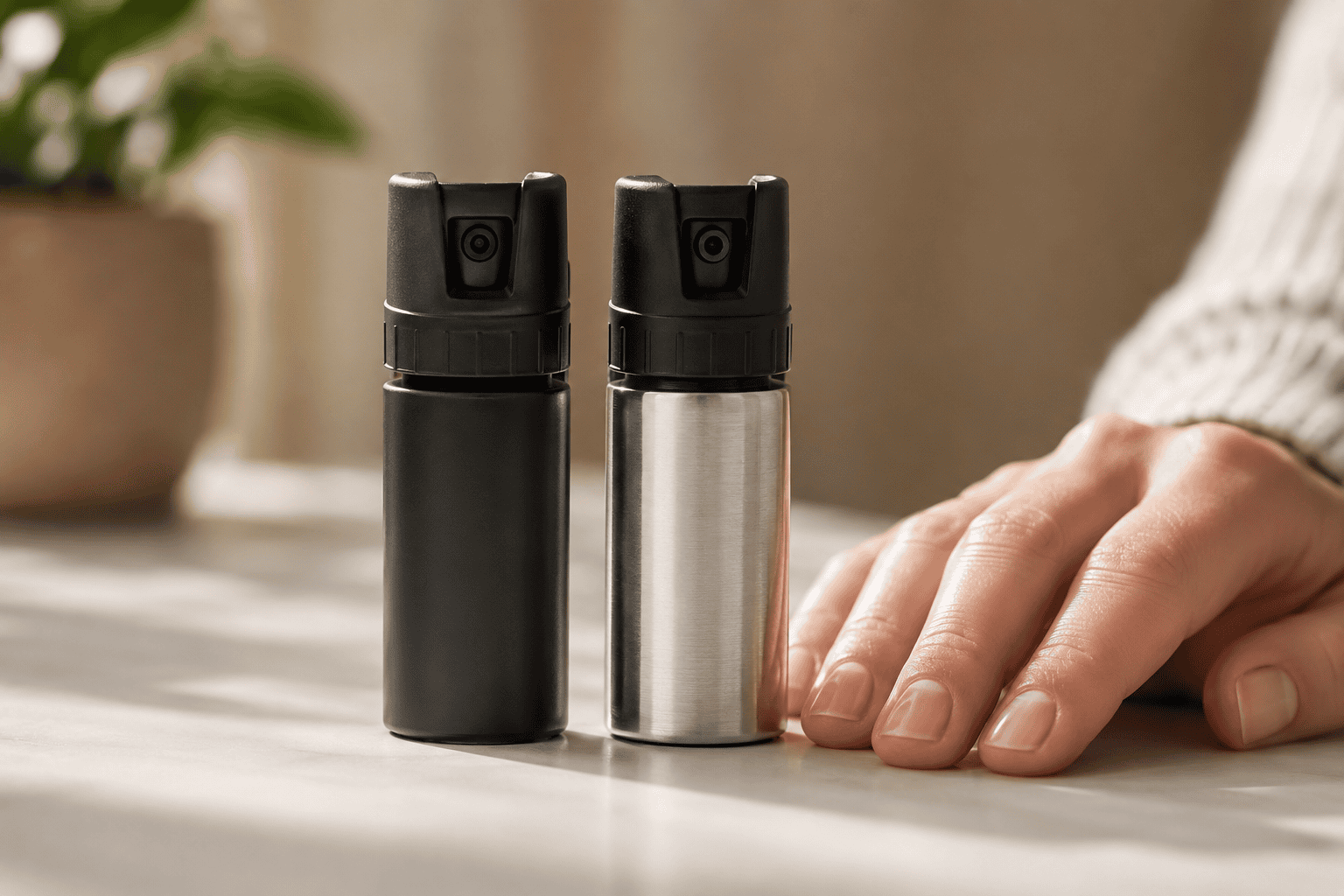
Pepper Spray Versus Mace? Quick Answer: In everyday conversation, people use “pepper spray” and “Mace” interchangeably – but they are not the same thing. Pepper spray is a broad category of OC (oleoresin capsicum) sprays derived from hot peppers, while Mace is a brand name that now makes OC-based products but originally used a completely different chemical compound. For most people choosing a personal defense spray today, a quality OC pepper spray is the right call.
Pepper spray is an aerosol product that uses oleoresin capsicum – a natural oil extracted from hot chili peppers – as its active ingredient. When sprayed at an attacker, OC causes an immediate inflammatory response: the eyes slam shut, the airways constrict, and intense burning sensations affect the face, skin, and mucous membranes. The effects are real, they are involuntary, and they typically last 20 to 45 minutes – giving you time to get away from danger.
The potency of a pepper spray is measured by its SHU (Scoville Heat Units) and, more practically, by the percentage of OC it contains. A higher OC percentage does not automatically mean a more effective spray – what matters more is the heat rating of the OC used and the delivery method. A well-formulated 1.33% Major Capsaicinoids (MC) pepper spray will outperform a poorly made 10% OC product every single time. This is why understanding the label matters more than picking the one with the biggest number on the package.
Pepper spray works on most people, regardless of pain tolerance, intoxication level, or emotional state, because the inflammatory response is physiological – not psychological. That is one of its most important qualities as a defensive tool.
Mace is a brand – specifically, Mace Brand – that has been around since the 1960s. The original Mace formula used CN gas (chloroacetophenone), which is a tear gas compound. CN gas works primarily as an irritant and is more of a psychological deterrent than a physiological one. It is significantly less effective on people who are highly agitated, intoxicated, or have a high pain threshold. For this reason, law enforcement largely moved away from CN-based products.
Here is where the confusion starts: Mace Brand reformulated many of its products years ago to use OC as the active ingredient, just like standard pepper spray. So today, when you buy a canister labeled “Mace,” you are often buying an OC-based pepper spray from a company that happens to be called Mace. The name stuck in the public consciousness from the original product, and it never quite let go.
Some Mace Brand products now combine OC with CN or UV dye – a marking agent that can help law enforcement identify an attacker after the fact. These combination formulas are not inherently bad, but for a first-time buyer, the most important question is always: does this product use OC as its primary active ingredient? If yes, you are in solid territory.
When both products use OC as the primary active ingredient, effectiveness comes down to formulation quality, spray pattern, and range – not the brand name on the label. Pure OC pepper spray from a reputable manufacturer is the benchmark against which everything else is measured.
Old-formula CN-based Mace is less effective and harder to find. If you come across a product that uses CN as its only active ingredient, skip it. It is an outdated approach that does not hold up well in real-world conditions.
Modern OC-based Mace Brand products perform comparably to other quality pepper sprays. The playing field has largely leveled out. What you should focus on instead of the brand name is the delivery mechanism, the spray pattern, and whether the canister size fits your lifestyle and carry habits.
This is one of the most practical decisions you will make when choosing a defense spray, and it is worth taking a moment to understand your options.
For everyday carry, I usually point people toward a stream or gel formula. Both give you good range, reduce blowback risk, and work well across a variety of environments. If you spend a lot of time indoors or in enclosed spaces, gel is worth the slight extra attention to aim.
Legally speaking, most state laws regulate defense sprays by category – not by brand name. The laws typically address OC concentration limits, canister size limits, age restrictions, and in some cases, approved formulas. Whether your canister says “pepper spray” or “Mace” on the label matters far less than whether OC is the active ingredient, because that is what the regulations are written around.
A few important notes: Some states restrict the percentage of OC you can carry. A handful of states have more specific regulations around CN gas or combination formulas. If you are traveling, check the laws of each state you will be in. And always confirm your state’s current laws before purchasing – regulations do change, and I am not a lawyer. The point is that “Mace” does not carry any special legal status compared to “pepper spray.” They are treated the same under virtually every state’s framework.
Canister size determines how many bursts you have available and how easy the spray is to carry. Here is a simple way to think about it:
Do not let the idea of “more is always better” push you toward a canister you will leave in your car because it is too awkward to carry. The best pepper spray is the one you actually have with you. A small, well-formulated canister in your pocket beats a large one sitting in a glove compartment every single time.
Buying a pepper spray canister and tossing it in a drawer is not a safety plan – it is a false sense of security. A few simple habits make a real difference.
First, check the expiration date. Most defense sprays have a shelf life of two to four years. The propellant weakens over time, which reduces range and spray pressure. Mark the date on your calendar and replace it before it expires.
Second, practice the motion. You do not need to spray the product to practice – just get comfortable drawing the canister, releasing the safety mechanism, and orienting the spray nozzle toward a target. Under stress, fine motor skills deteriorate. Muscle memory bridges that gap. Run through the motion a dozen times until it feels natural.
Third, if you have an older canister approaching its expiration, take it outside on a calm day and do a brief test spray. See the actual range and pattern. That single experience is worth more than reading ten product descriptions.
Finally, store your spray somewhere accessible, not somewhere “safe.” A pepper spray locked in a safe is useless in an emergency. Keep it where you can reach it quickly, and make sure it stays out of reach of children.
Not historically, but largely yes today. The original Mace formula used CN tear gas, which is a different compound from OC pepper spray. Mace Brand has since reformulated most of its products to use oleoresin capsicum as the primary active ingredient. When you buy a modern Mace Brand canister, you are usually buying an OC-based product – the same core ingredient found in standard pepper sprays from other manufacturers.
Yes, but the spray pattern matters. A cone or fogger pattern in an enclosed space can affect you as well as your attacker. For indoor use, a gel or stream formula is a much smarter choice. Gel in particular sticks on contact, minimizes airborne particles, and significantly reduces the risk of blowback in hallways, offices, or other tight spaces.
Pepper spray is effective on the vast majority of people because it triggers a physiological inflammatory response rather than relying on pain compliance. That said, no defensive tool is 100% reliable in every situation. People with certain conditions or extremely high adrenaline may have a delayed reaction. This is why pepper spray is best understood as a tool to create distance and escape, not a guaranteed stop.
The primary effects – eye closure, intense burning, difficulty breathing – typically last 20 to 45 minutes. This window is designed to give you time to get away from danger and reach safety. Full recovery, including residual skin irritation, can take a few hours depending on exposure level and how thoroughly the area is flushed with water and mild soap.
UV dye is a marking agent that is invisible to the naked eye but glows under ultraviolet light. It is included in some pepper spray formulas to help law enforcement identify an attacker after the fact, since the dye is difficult to wash off quickly and stays on skin and clothing. It is a helpful addition but secondary to the OC formula itself in terms of practical defense value.
Most states require buyers to be at least 18 years old to purchase pepper spray. Some states allow minors to carry it with parental consent. A few states have additional restrictions on formula type or canister size. Always check your specific state’s laws before purchasing, and when in doubt, a quick call to your local law enforcement non-emergency line can give you a clear answer.
Check the expiration date printed on the canister – most sprays are rated for two to four years from manufacture. As the canister ages, the propellant pressure decreases, which reduces range and spray force. If your canister is approaching its expiration date, do a test spray outside and replace it if the pressure or range seems weak. Treat it like a smoke detector battery: replace it on schedule, not after it fails.
Yes – pepper spray is one of the most versatile and accessible non-lethal tools available, and it complements other options well. It works at distance, requires no special licensing in most states, and can be deployed quickly under stress. Having layered options appropriate to different situations is a smart approach to personal safety. Pepper spray is often the first line of response precisely because it gives you a way to create distance and escape without escalation.
Carry a quality OC pepper spray – whether it says “pepper spray,” “Mace,” or any other brand on the label. What matters is that OC is the primary active ingredient, that the formula comes from a reputable manufacturer, and that the canister size and spray pattern fit your actual life and carry habits.
The pepper spray versus Mace debate is mostly a relic of terminology – a brand name that outlasted the original product it described. Today, both terms usually point to the same underlying technology. Focus your energy on the right spray pattern for your environment, a canister size you will actually carry, and the habit of keeping it accessible and current.
If you have questions about which specific product makes sense for your situation, I am always happy to help you think it through. That is what we are here for.








We use cookies to improve your experience on our site. By using our site, you consent to cookies.
Manage your cookie preferences below:
Essential cookies enable basic functions and are necessary for the proper function of the website.
These cookies are needed for adding comments on this website.
Statistics cookies collect information anonymously. This information helps us understand how visitors use our website.
Google Analytics is a powerful tool that tracks and analyzes website traffic for informed marketing decisions.
Service URL: business.safety.google (opens in a new window)