
U.S. Legal in Most States • Discreet Shipping • Real-World Protection • No Permits Required in Most Areas
U.S. Legal in Most States • Discreet Shipping • Real-World Protection • No Permits Required in Most Areas
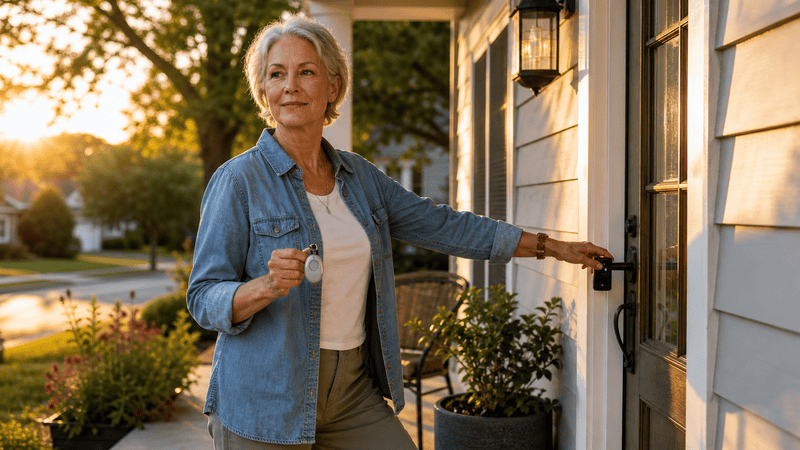
The eight best safety gifts for an elderly mother who lives alone are a 130dB personal alarm, a door alarm for every entry point, a GPS-enabled personal locator, a discreet hidden camera system, a pepper spray formulated for arthritic hands, a window break sensor, a stun device with a disable pin, and a diversion safe — each solving a distinct vulnerability that a single gift card or deadbolt upgrade cannot address.
Most people shopping for an elderly parent’s safety default to the same two categories: a medical alert device or a new lock. Both are useful. Neither is sufficient. The actual threat profile of a senior woman living alone is more layered than a single product can cover — it includes perimeter security, in-home surveillance, personal defense during an outing, emergency communication, and the everyday risk of a fall or medical event that goes unwitnessed. Approaching this as a systems problem rather than a single-product problem changes what you buy entirely. This list reflects that approach.
The conventional answer — get her a medical alert pendant — addresses exactly one scenario: a fall inside the home where she remains conscious and can press a button. It does nothing for the intruder who comes through an unlocked back door at 2 a.m., the scam artist who knocks at noon, or the parking lot that she crosses alone after a doctor’s appointment. Medical alert devices are valuable. They are also wildly incomplete as a safety strategy.
The more accurate model treats your mother’s daily environment as a series of distinct exposure zones: her perimeter (doors, windows, yard), her interior (living spaces, bedroom), her person (when she leaves the house), and her communication layer (who knows where she is and when to worry). A complete safety gift plan covers all four. The eight tools below map directly to those zones, and most of them can be deployed without a professional installer, a smartphone app requirement, or a subscription fee.
One more reframe worth making: the best safety tools for elderly women are not dumbed-down versions of self-defense products. They are purpose-engineered for real-world constraints — grip strength limitations, medication that slows reaction time, reluctance to appear alarmed in public. That specificity is where the innovation in modern non-lethal tools is actually happening.
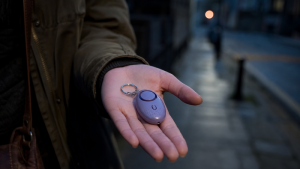
A personal safety siren is the most operationally simple tool on this list and the one with the highest probability of actually being used in a crisis. There is no trigger pull, no safety to disengage, no charging delay. Pull the pin or press the button — 130 decibels of attention-demanding sound activates instantly. At that output level, the alarm is audible from over 1,000 feet in open air and is physiologically disorienting to anyone within close range.
For elderly users specifically, the critical design detail is the activation mechanism. Look for alarms that use a pull-pin design rather than a push button: a pin can be yanked even with reduced grip strength, and it activates without requiring the user to locate a small button under stress. Many models attach directly to a purse strap, walker frame, or keychain — keeping the tool accessible without requiring a separate carry decision every time she leaves the house.
The broader category of personal alarms for elderly users includes models with built-in LED lights, wrist-strap designs for fall detection alerting, and hybrid units that combine the siren with a locator beacon. If she walks her neighborhood alone or drives to appointments independently, this is the non-negotiable starting point.
Residential burglars operate on a simple cost-benefit model: time, noise, and visibility determine whether a target is worth approaching. Door and window sensors that emit an immediate alarm on breach — typically 100 to 120dB at the sensor itself — reset that calculation. The alarm fires before the intruder is inside. That pre-entry deterrence is categorically different from an alarm that notifies a monitoring center after the door opens.
For a home with multiple entry points — front door, back door, garage entry, ground-floor windows — the layered approach matters. A single door alarm on the front entry leaves the sliding glass door as an obvious workaround. Magnetic contact sensors are the most reliable technology for this application: two-part units where breaking the magnetic connection between the door frame and the door itself triggers the alarm. Installation requires no wiring, no hub, and no subscription. A 3M adhesive strip is the only tool required. This is a gift that can be installed in 20 minutes during a visit.
For a deeper look at door alarm configurations for women living alone, the post on door alarms for women living alone covers specific placement strategy and product selection criteria worth reviewing before you buy.
The threat profile here is different from a standard home security camera setup. For an elderly woman living alone, the most significant risks captured on camera are not always external intruders — they include in-home service workers, caregivers, and visitors whose behavior may not be visible to family members who aren’t present. A hidden camera for elderly care positioned discreetly in common areas creates a verification layer that a doorbell camera cannot replicate.
Modern hidden cameras occupy everyday objects — alarm clocks, smoke detectors, picture frames — with motion-activated recording, loop recording to an internal SD card, and wide-angle lenses covering 120 to 150 degrees of a room. Many models now include local storage only, which eliminates the subscription cost and keeps recorded footage off third-party servers. For families where privacy is a concern, this is a relevant distinction. The goal is documented awareness, not surveillance theater.
It is — but the standard flip-top canister designed for a 30-year-old is not the right tool. The critical engineering variables for elderly users are the activation force required, the nozzle design (stream versus cone spray pattern), and the canister size relative to her hand. A cone or fog spray pattern requires less precise aim than a direct stream, which is a meaningful advantage when stress degrades fine motor control. A smaller canister — 1/2 oz to 3/4 oz — fits more naturally into a small hand and is less likely to be left at home because it fits a purse pocket.
Formulation matters. Look for products in the 1.33% to 2% Major Capsaicinoids (MC) range — that is the measure of actual inflammatory strength, not the Scoville heat units figure that some manufacturers lead with. Brands including Mace, Pepper Shot, and WildFire offer formulations at or above this threshold with stream and fog delivery options. Pepper spray for elderly defense is an underutilized category — most families don’t consider it because of a reflexive assumption that it’s too complicated to use. A 20-minute practice session with an inert training canister resolves that concern.
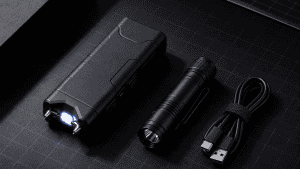
The design variables that matter most for elderly users are the same ones that make a stun device reliable under stress for any user: a large activation surface instead of a small button, a built-in safety switch that prevents accidental discharge, and a disable wrist strap that cuts power if the device is taken away. The Runt stun gun, for example, offers a rubberized grip surface and a built-in LED for low-light navigation — details that reflect practical engineering, not afterthought features.
The Streetwise and Stun Bat product lines include extended-reach designs that allow the user to create distance between herself and an attacker before discharging the device. For a user who may not be able to physically close distance or hold ground in a confrontation, that additional 12 to 18 inches of effective reach is operationally significant. If you’re newer to evaluating these devices, the post on stun gun safety features walks through the specific features worth prioritizing.
A diversion safe is a container engineered to look identical to an ordinary household product — a can of hairspray, a book on a shelf, a wall outlet — while functioning as a secured storage compartment. The concept exploits a well-documented principle in residential theft: burglars spend an average of 8 to 12 minutes inside a target home and prioritize obvious locations — master bedroom, dresser drawers, nightstands. A diversion safe in the bathroom cabinet or on the kitchen pantry shelf defeats that search pattern entirely.
For an elderly woman living alone, the contents worth securing are not just cash and jewelry. Prescription medications — particularly opioid-based pain management drugs — are high-value targets in residential burglaries. A book safe or canister safe on a bathroom shelf is invisible to a thief operating on a time budget. This is one of the most cost-effective items on this list and one of the least obvious — which is precisely the point.
A 130dB personal alarm is the highest-priority starting point. It requires no strength, no practice, and no complex operation under stress — pull the pin and the alarm activates. It addresses the most common high-danger scenario: being approached or threatened in a public space. Pair it with door alarms for home security coverage and you’ve addressed the two highest-risk exposure zones.
At 130 decibels, a personal alarm is louder than a chainsaw at close range and is physiologically disorienting to someone standing within 10 feet. At that output level, the alarm draws immediate attention from bystanders, which is the primary deterrence mechanism. Research on predatory behavior consistently shows that unwanted attention is the most effective deterrent — a 130dB siren creates that attention within seconds.
The relevant question is whether anyone enters her home without you being present — caregivers, cleaners, repair workers, neighbors. If the answer is yes, a hidden camera in common areas provides documented verification that protects her. Position cameras in living rooms and entry areas rather than private spaces, and ensure she is aware of and comfortable with the system. Local storage models that don’t require cloud subscriptions address most privacy concerns.
Yes, with the right product selection. A cone or fog spray delivery pattern requires far less precise aim than a stream design. A smaller canister — 1/2 oz — fits naturally in a smaller hand. Brands including Mace, Pepper Shot, and WildFire offer grip-friendly designs. A brief practice session with an inert training unit builds the muscle memory needed to activate under stress, which is the most important preparation step.
A 130dB personal alarm is audible at approximately 1,000 feet in open outdoor environments. In an urban or suburban setting with ambient noise and building interference, effective attention-drawing range is typically 200 to 400 feet — still sufficient to draw response from neighbors, passersby, or parked vehicles. Indoor effectiveness in a hallway or building is higher due to sound reflection.
A stun device with a built-in safety switch and wrist disable strap is designed precisely to prevent accidental discharge and resist being turned against the user. For elderly users, the key selection criteria are a large activation surface, a rubberized grip, and a built-in LED light. A brief orientation session covering the safety mechanism and activation method is all the training required to use it effectively.
Every operable entry point at ground level should be covered: front door, back door, side doors, sliding doors, and all ground-floor windows that can be opened from outside. A single-door alarm is a partial measure. The burglary deterrence effect depends on total perimeter coverage — a gap in that perimeter is a known vulnerability. Magnetic contact sensors are inexpensive enough that covering a full home costs well under $100.
Prescription medications — especially controlled substances — are the highest-priority contents given their appeal to residential burglars. Cash, jewelry, and a spare credit card are secondary priorities. Important documents including a spare house key, medical power of attorney paperwork, and emergency contact information are also appropriate. The goal is to move high-value, high-sensitivity items out of predictable locations like bedroom nightstands and into a camouflaged container in a less searched area.
The safest homes for elderly women living alone are not the ones with the most locks — they are the ones where every zone of daily life has a purpose-built tool covering its specific exposure. A personal alarm solves a different problem than a door sensor, which solves a different problem than a hidden camera, which solves a different problem than a pepper spray on a keychain. Stack those solutions correctly and you have not just a gift — you have a system. That is the shift worth making this year.
Browse the full selection of personal alarms for elderly users at Nittany Self Defense to find the specific configurations and features that match her daily routine — or start with the personal safety siren if you need the highest-impact single tool to give first.




We use cookies to improve your experience on our site. By using our site, you consent to cookies.
Manage your cookie preferences below:
Essential cookies enable basic functions and are necessary for the proper function of the website.
These cookies are needed for adding comments on this website.
Statistics cookies collect information anonymously. This information helps us understand how visitors use our website.
Google Analytics is a powerful tool that tracks and analyzes website traffic for informed marketing decisions.
Service URL: business.safety.google (opens in a new window)