

U.S. Legal in Most States • Discreet Shipping • Real-World Protection • No Permits Required in Most Areas
U.S. Legal in Most States • Discreet Shipping • Real-World Protection • No Permits Required in Most Areas
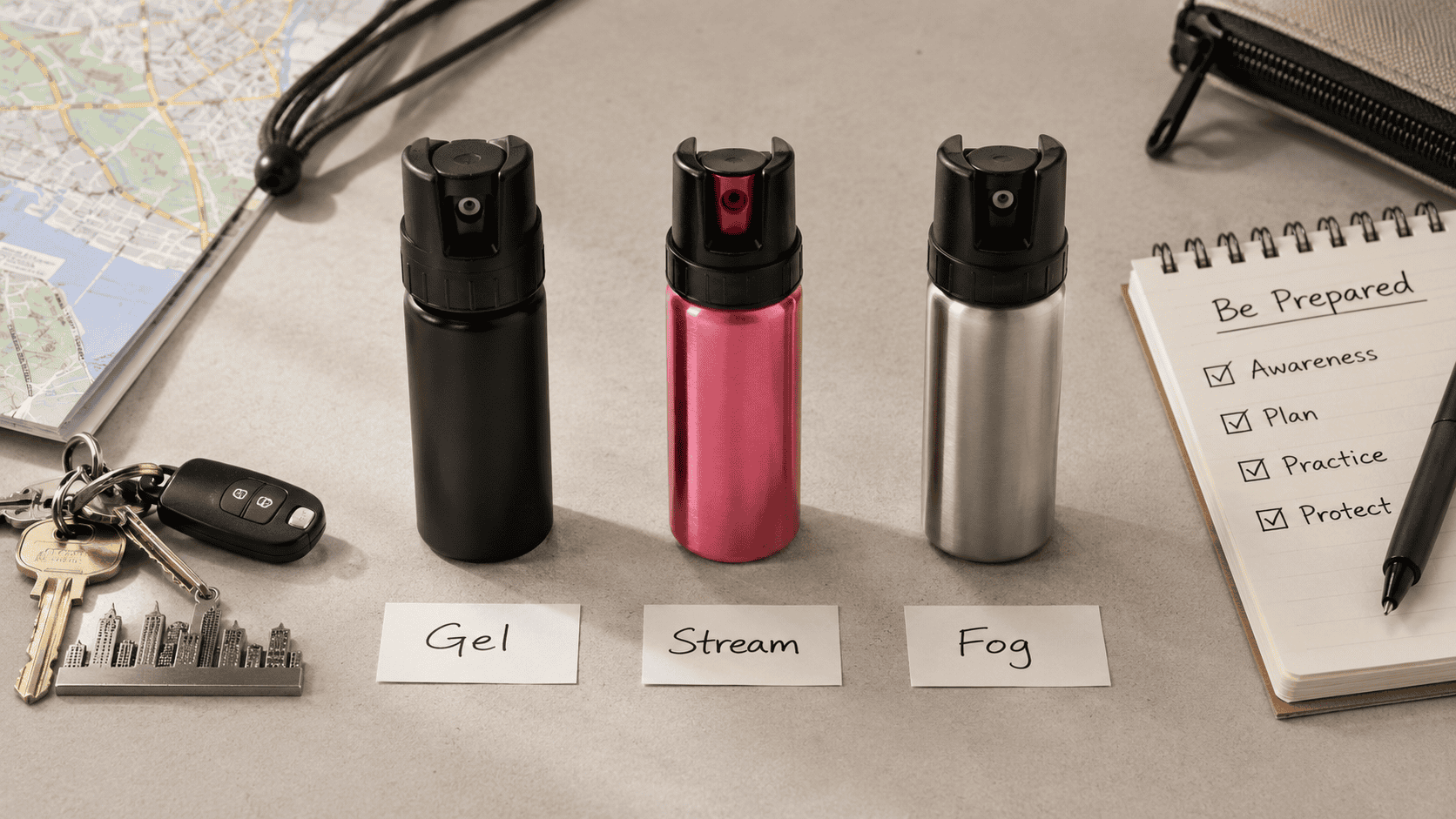
Gel vs Stream vs Fog? Quick Answer: Gel is your best choice for indoor use and windy conditions because it sticks to a target and won’t blow back. Stream gives you a focused, longer-range shot with less contamination risk. Fog covers a wide area fast but carries the highest blowback risk and works best in open outdoor spaces. Your environment – not personal preference – should drive this decision.
Most people assume all pepper spray is the same – point, press, done. That assumption could leave you in real danger. The formula determines how far the spray travels, how easily it can contaminate you or bystanders, whether it works indoors, and how accurately you can deploy it under stress. Choosing the wrong formula for your situation isn’t just ineffective – it can actually work against you.
Here’s what you need to know before you ever touch that trigger. The three main delivery formats – gel, stream, and fog – each have a distinct behavior profile. Matching that profile to your real-world environment is one of the most important safety decisions you can make.
Gel formula is the right call when you’re inside a building, in a vehicle, or dealing with wind. Gel is exactly what it sounds like – a thick, viscous substance that behaves more like a projectile than a mist. It travels in a tight, sticky stream and clings to whatever surface it hits, including a person’s face. That sticking action actually intensifies the effect over time, because the subject can’t easily wipe it away without spreading it further.
The critical safety advantage of pepper spray gel is dramatically reduced blowback. Because it doesn’t atomize into fine particles, there’s very little airborne contamination. That makes it the standout choice in enclosed spaces like hallways, parking garages, stairwells, and inside your home. It also performs reliably in moderate winds that would send a fog or fine stream drifting sideways – right back at you.
Gel is the right choice if you:
Important warning: Gel has a shorter effective range than some stream formulas and requires more accurate aim. You need to practice your draw and deployment technique so that aiming under stress becomes second nature.
Stream is the most versatile all-around formula, and it’s what most people should default to if they aren’t sure which type to choose. A stream formula shoots a tight, liquid jet of concentrated OC (oleoresin capsicum) solution. It behaves similarly to a squirt gun – a defined, predictable trajectory that gives you more control over where the spray goes.
Pepper spray stream typically offers a longer range than fog – often 10 to 15 feet – and has a much lower blowback risk than fog formula. It’s effective outdoors and can be used indoors in a pinch, though gel is the better indoor choice. The stream is accurate enough to target a face precisely, and the liquid concentration delivers a strong, immediate response.
Stream is the right choice if you:
Critical note: Stream is still susceptible to wind. If you’re deploying into a strong headwind, any formula can partially return to you. Always position yourself upwind when possible before deploying.
Fog formula – sometimes called cone or mist – releases a wide spray cloud of fine OC particles. Because the particles are so small and airborne, fog creates a large contaminated zone very quickly and is extremely difficult to avoid walking into. It requires less precise aim than stream or gel, which can be a genuine advantage in a chaotic or high-stress situation.
Pepper spray fog is best suited for open outdoor environments with good air circulation and no bystanders in close proximity. It’s often chosen for jogging in parks, hiking, or other open-air activities where you might face a threat at close range and need rapid area coverage. Some people who walk dogs in areas with wildlife also choose fog for this reason.
Fog is the right choice if you:
Critical warning – read this carefully: Fog has the highest blowback risk of all three formats. In any wind whatsoever, fine OC particles can drift back toward you. If you deploy fog indoors, you will contaminate the entire room – including yourself. Never carry fog as your primary formula if you spend significant time in enclosed spaces or urban environments. The very quality that makes fog effective – widespread airborne particles – is also its biggest liability.
Use this comparison to quickly identify which format fits your life. Honest self-assessment here could make a real difference in an emergency.
The formula is the most important decision, but it’s not the only one. Before you carry any pepper spray, work through this checklist – skipping any item is a real risk.
Yes, gel works outdoors and is actually an excellent choice for windy outdoor environments because it resists blowback. However, if you’re in wide-open spaces with no wind concerns and want faster area coverage, a stream formula is also a solid option. Gel’s main advantage outdoors is when wind is a factor or when accurate targeting matters more than coverage area.
Absolutely – and this is critical. Fog formula releases fine airborne particles that will quickly contaminate any enclosed space, including the interior of a vehicle. If you deploy fog inside a car, you will almost certainly affect yourself and any passengers. Gel is the correct choice for vehicle carry. Never use fog in any enclosed environment under any circumstances.
Check the expiration date printed on the canister – most are good for 2-4 years from manufacture. Even within the expiration window, store your spray away from extreme heat (like a hot glove compartment in summer), which can degrade the propellant and reduce range. Replace any canister that has been partially discharged, shows corrosion, or is nearing its expiration date.
Modern Mace brand products typically contain OC (oleoresin capsicum), the same active ingredient as other pepper sprays – so the distinction is now mostly a brand name difference rather than a formula difference. Original Mace was a chemical irritant (CN tear gas), which has largely been replaced by OC formulations. When evaluating any product, focus on the OC concentration and Major Capsaicinoids percentage, not the brand name.
OC pepper spray affects the eyes and respiratory system through a direct physiological mechanism – it causes involuntary eye closure, mucous membrane irritation, and temporary breathing difficulty. This reaction occurs even in people who are intoxicated or in an altered state, although their pain response may be reduced. Stream and gel formulas can still be effective, but there are no guarantees in any self-defense situation.
You want to be far enough to be out of arm’s reach – generally at least 6 to 8 feet – but close enough to be within your spray’s effective range. Stream formulas can reach 10-15 feet. Gel reaches 8-12 feet. Creating distance is always preferable if you have the option. The closer you are, the higher the risk of partial blowback or the subject reaching you before the spray takes effect.
Yes – this is one of the most important things you can do. Drawing your canister, disengaging the safety, and aiming takes coordination that must become automatic. Under adrenaline and stress, fine motor skills degrade significantly. Purchase an inert training unit with the same form factor as your carry canister and practice your draw and deployment until it feels instinctive. Carrying without practicing is far better than not carrying at all, but practicing is far better than either.
Here’s the honest bottom line: if you spend most of your time in and around buildings, in your car, or in any urban environment, gel is your safest and most responsible choice. If you’re primarily outdoors and want a reliable all-weather option with good range, a quality stream formula is your best bet. If you hike, trail run, or spend extended time in open outdoor spaces, fog can be appropriate – but only with a clear understanding of its limitations and serious wind awareness.
The formula you choose should match where you actually live your life – not the scenario that feels most dramatic to imagine. Take stock of your daily environment, pick the formula that genuinely fits, learn how to use it correctly, and replace it before it expires. That’s not overkill – that’s just being genuinely prepared.







We use cookies to improve your experience on our site. By using our site, you consent to cookies.
Manage your cookie preferences below:
Essential cookies enable basic functions and are necessary for the proper function of the website.
These cookies are needed for adding comments on this website.
Statistics cookies collect information anonymously. This information helps us understand how visitors use our website.
Google Analytics is a powerful tool that tracks and analyzes website traffic for informed marketing decisions.
Service URL: business.safety.google (opens in a new window)