

U.S. Legal in Most States • Discreet Shipping • Real-World Protection • No Permits Required in Most Areas
U.S. Legal in Most States • Discreet Shipping • Real-World Protection • No Permits Required in Most Areas
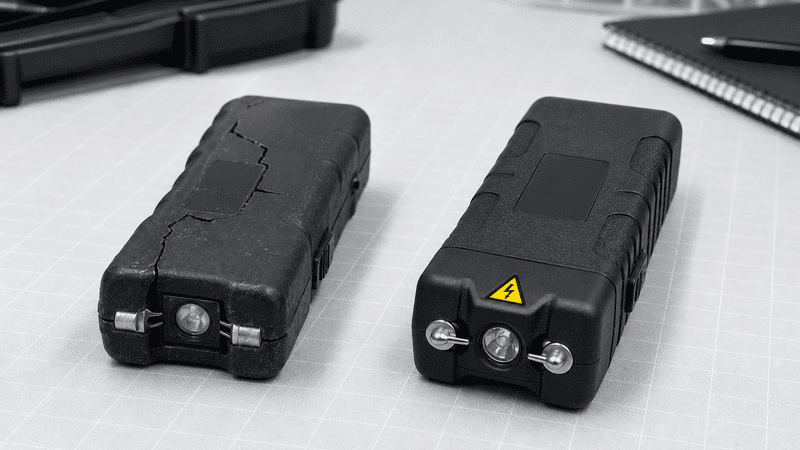
Want to know how to spot a quality stun gun? Shopping for a stun gun can be more confusing than it first appears. Product listings often emphasize enormous voltage numbers, dramatic names, and long feature lists, but those things don’t necessarily tell you whether a device is well made, practical to carry, or backed by a manufacturer you can rely on.
A better approach is to evaluate the complete product: who makes it, what information the manufacturer provides, how its safety features work, how it is powered, whether it appears well constructed, and what kind of warranty and support stand behind it. Those factors can tell you considerably more than one impressive-looking number on the package.
Voltage is one of the most heavily advertised stun gun specifications, which makes it tempting to compare devices simply by choosing the largest number.
That’s not a particularly useful approach. Voltage describes electrical potential, but it doesn’t describe every characteristic of a stun gun’s electrical output. Current, electrical charge, pulse characteristics, circuitry, test conditions, and overall device design can also matter.
That doesn’t make voltage meaningless. It simply means that a voltage number shouldn’t be treated as a performance score.
Be especially cautious when a product listing seems built almost entirely around an enormous electrical number while providing very little useful information about the device itself. Good product information should help you understand what you’re buying rather than relying primarily on a headline specification.
One of the most useful ideas when comparing stun guns is to evaluate the company behind the product as carefully as the product itself.
An established brand should be reasonably easy to identify. You should be able to find product information, operating instructions, warranty terms, and some way of contacting the manufacturer or seller if something goes wrong.
That doesn’t mean an unfamiliar brand is automatically poor quality or that a familiar name guarantees a perfect product. It does mean that accountability matters. If you can’t determine who made a device, who stands behind it, or where to obtain support, you’re accepting more uncertainty before you’ve even made the purchase.
A warranty isn’t proof that a stun gun will never fail, but it does tell you something important: the manufacturer has established a process for dealing with a product that does.
Before purchasing, look at what the warranty actually covers and how long the coverage lasts. Also consider whether replacement instructions, customer-service information, and return policies are clearly explained.
Be more cautious when a seller provides no meaningful warranty information, no obvious customer-support channel, and vague or restrictive return terms. Those aren’t necessarily proof of a bad product, but taken together they give you fewer options if the device arrives defective or develops a problem later.
A stun gun is an electrical personal safety device, so preventing unintended activation should be part of its design.
Many models use a physical safety switch or a multi-step activation system. Some incorporate additional features such as wrist-strap disable pins or visible indicators showing that the device is powered on. Designs vary, so not every quality stun gun will have exactly the same safety system.
What’s important is that the manufacturer clearly explains how its safeguards work and that you can understand the controls before carrying the device.
If a product listing barely mentions safe operation or leaves you guessing about how accidental activation is prevented, that’s a reasonable reason to look more closely before buying.
Specifications aren’t the only way to judge quality. A personal safety device also needs to make sense as a physical product.
Look for obvious signs of thoughtful construction: a casing that appears securely assembled, controls that are clearly positioned, charging connections that don’t look unusually fragile, and a design that can be handled comfortably.
Size matters too. A very small stun gun may be easier to carry, while a larger model may offer a different grip or additional features. Neither approach is automatically better. The question is whether the design fits the way you realistically expect to carry and store it.
Features such as a flashlight, alarm, wrist strap, holster, or rechargeable battery can add convenience, but more features don’t automatically mean better quality. A simpler device that performs its intended functions reliably may be a better choice than one overloaded with extras you don’t need.
A stun gun depends on its power source, making battery design an important part of the buying decision.
Some devices use rechargeable internal batteries, while others use replaceable batteries. Either arrangement can be practical when the device is designed properly and maintained according to the manufacturer’s directions.
Look for clear charging or battery instructions and an understandable way to determine whether the device is ready for use. Avoid assuming that all rechargeable stun guns require the same charging schedule or that every battery should be replaced on the same timetable.
The manufacturer’s instructions for your particular model should determine how it is charged, tested, stored, and maintained.
Documentation may not be the first thing shoppers think about, but it can reveal quite a bit about the company behind a stun gun.
A well-supported product should generally provide enough information for you to understand its controls, safety system, power source, charging or battery requirements, basic maintenance, and intended operation.
Compare that with a listing consisting primarily of dramatic graphics, promotional claims, and a few impressive numbers but little practical information. The second product may look more exciting on the screen, but it gives you less information with which to make an informed decision.
Clear instructions aren’t glamorous. They’re simply one sign that a manufacturer has thought about what happens after the sale.
Customer reviews can be useful, particularly when the same issue appears repeatedly. Buyers may identify problems involving switches, charging ports, battery retention, cases, holsters, or customer support that aren’t obvious from a product description.
But star ratings shouldn’t be your only quality test. Individual reviews can be subjective, products can change over time, and a reviewer’s expectations may differ from yours.
Instead, look for patterns. Repeated reports of the same defect deserve more attention than one unusually positive or negative comment. Manufacturer documentation, warranty coverage, product specifications, and seller support should be considered alongside customer feedback.
No single warning sign automatically proves that a stun gun is poor quality. But several warning signs appearing together should make you more cautious.
None of these requires becoming an electrical engineer. They’re simply common-sense ways to distinguish a well-documented consumer product from one asking you to buy largely on faith.
A quality stun gun still needs to fit its intended use. Someone carrying a compact device while exercising may have different priorities from someone choosing a larger model primarily for storage at home.
For example, our guide to stun guns for runners looks at considerations that become more important when size and portability matter. We also discuss issues associated with stun guns for college campus carry, where portability must be considered alongside applicable campus and local rules.
The important point is to evaluate quality in context. A feature that is valuable for one person may add little for someone else.
Rather than asking which stun gun brand is universally “best,” ask whether a manufacturer gives you good reasons to trust its products.
Useful questions include:
This approach is more useful than assuming that one brand name automatically guarantees quality. It also gives you a consistent framework for comparing established manufacturers with brands you may not recognize.
A higher price can reflect better materials, additional features, stronger support, or a longer warranty, but price alone doesn’t prove quality.
The reverse is also true. An inexpensive stun gun isn’t automatically unreliable simply because it costs less.
Instead of treating price as the deciding factor, ask what you’re receiving for the money. Is the product well documented? Does the design fit your needs? Are the safety features clear? Is there warranty support? Does the manufacturer provide useful information rather than relying primarily on marketing claims?
Value comes from the overall package, not simply from choosing the cheapest or most expensive option.
Even a well-made stun gun may not be appropriate to purchase or carry everywhere. Laws can vary by state and locality, and restrictions may involve possession, age, carrying, or particular locations.
Check current rules that apply where you live and anywhere you expect to carry the device. Product quality and legal suitability are separate questions, and both deserve attention before you make a decision.
Not necessarily. Voltage is only one characteristic of electrical output and shouldn’t be treated as an overall quality or effectiveness score. Consider the device’s design, documentation, safety features, manufacturer support, warranty, and other specifications as part of the comparison.
Designs vary, but look for a clearly explained system intended to reduce unintended activation. Depending on the model, this might include a physical safety switch, multi-step activation, visible status indicator, or disable-pin system.
A warranty doesn’t guarantee product quality, but it provides a way to address defects or failures and can be an indicator that the manufacturer supports its products. Read the actual warranty terms rather than assuming all warranties provide the same coverage.
Not automatically. Instead, investigate the company. Look for clear specifications, instructions, safety information, warranty coverage, customer support, and consistent product feedback. An unfamiliar company that provides good documentation may inspire more confidence than a heavily advertised product that provides very little useful information.
Follow the instructions for your particular model. Battery systems and manufacturer recommendations differ, so there isn’t one charging or testing schedule that should be applied to every stun gun.
No. Price can reflect construction, features, warranty coverage, branding, or other factors, but it isn’t a guarantee of quality. Evaluate the complete product and manufacturer rather than using price alone as your guide.
Warning signs include unclear manufacturer information, little or no warranty coverage, poorly explained safety features, inadequate operating instructions, repeated reports of the same defect, and listings that rely heavily on dramatic marketing claims while providing little practical product information.
Spotting a quality stun gun doesn’t require finding one magic specification. In fact, relying on a single number is one of the easiest ways to make a poor comparison.
Look at the complete device and the company behind it. Consider the construction, controls, safety system, power source, documentation, warranty, customer support, user feedback, and whether the design makes sense for the way you intend to carry or store it.
Most importantly, be willing to walk away when a product gives you more marketing than information. A manufacturer asking you to trust a personal safety device should also give you enough information to understand what you’re buying and how to maintain it responsibly.
Until later…..







We use cookies to improve your experience on our site. By using our site, you consent to cookies.
Manage your cookie preferences below:
Essential cookies enable basic functions and are necessary for the proper function of the website.
These cookies are needed for adding comments on this website.
Statistics cookies collect information anonymously. This information helps us understand how visitors use our website.
Google Analytics is a powerful tool that tracks and analyzes website traffic for informed marketing decisions.
Service URL: business.safety.google (opens in a new window)