

U.S. Legal in Most States • Discreet Shipping • Real-World Protection • No Permits Required in Most Areas
U.S. Legal in Most States • Discreet Shipping • Real-World Protection • No Permits Required in Most Areas
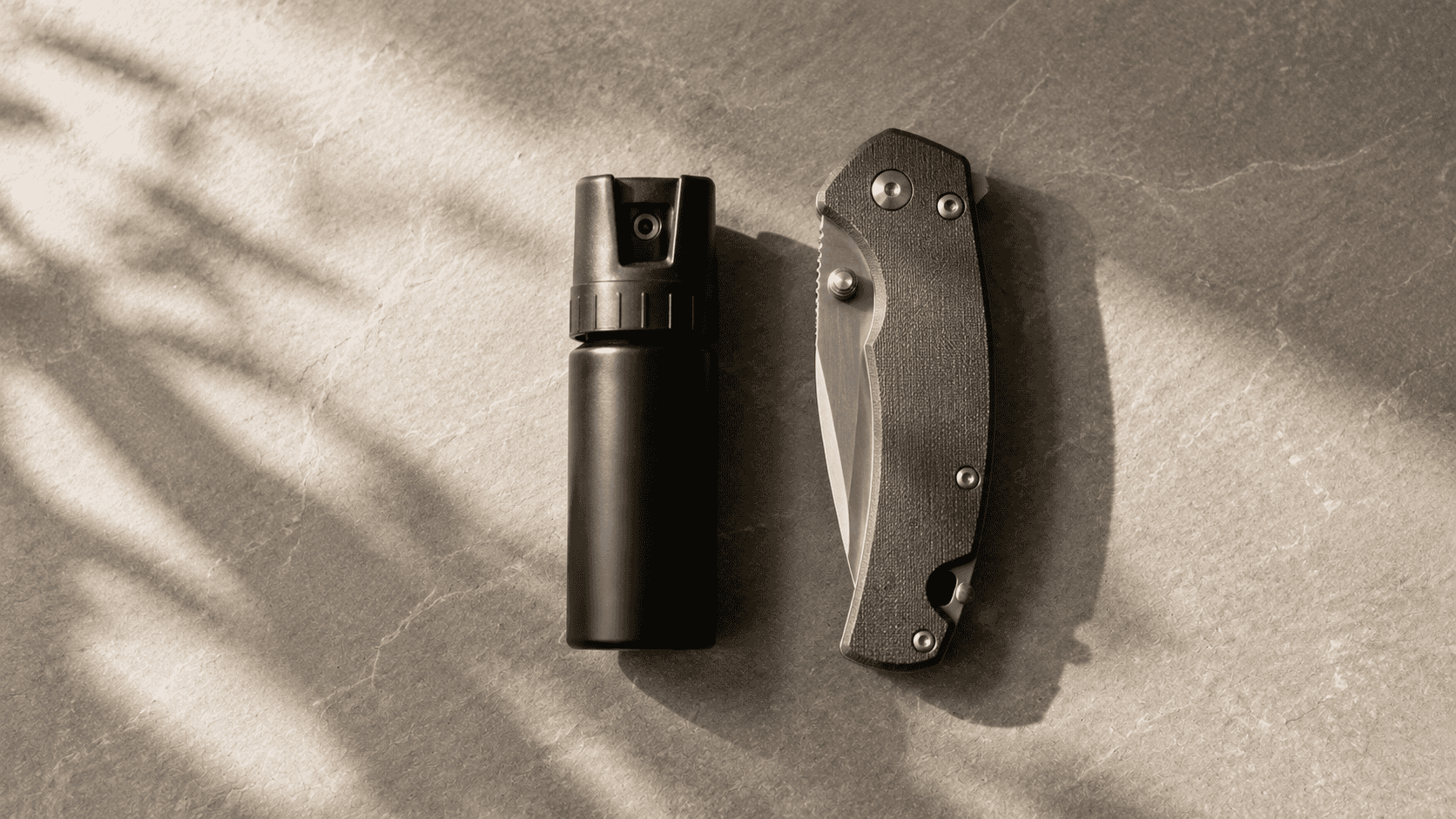
Knife Versus Pepper Spray? Quick Answer: For most everyday situations, pepper spray is the more practical, lower-risk self-defense option – it works at a distance, requires less training, and carries fewer legal complications than a knife. That said, the right choice depends on your lifestyle, your local laws, and how committed you are to learning how to use a tool safely and responsibly. Read on to make that call with confidence.
Choosing between a self-defense knife and pepper spray isn’t just a gear decision – it’s a commitment to a specific set of responsibilities, risks, and situations. The wrong choice, carried with the wrong mindset or without proper understanding, can actually make you less safe. Both tools have real value. Both have real limitations. And picking the one that fits your life – not some hypothetical tactical scenario – is what makes the difference between feeling prepared and actually being prepared.
Here’s what I want you to walk away with: a clear, honest picture of what each tool does well, where each one falls short, and a checklist you can use to make a thoughtful decision you feel confident about every day.
Pepper spray is the more accessible of the two options, and for good reason. It works by releasing oleoresin capsicum – the active compound derived from hot peppers – in a stream, cone, fog, or gel pattern toward a threat. On contact with eyes, skin, and mucous membranes, it causes an intense burning sensation, involuntary eye closure, and difficulty breathing. Most formulas take effect within seconds and can affect someone from anywhere between 6 and 20 feet away depending on the delivery type.
Here’s why that distance matters so much: it means you can potentially stop a threat before they reach you. That’s a critical advantage that a knife simply cannot offer.
One important warning: wind direction matters. If you’re carrying a stream formula outdoors, practice situational awareness about where the wind is coming from. A fog-style spray is particularly vulnerable to blowback. Know your product before you need it.
A self-defense knife is a close-range tool that requires a genuine commitment to training, legal awareness, and mental preparedness. This is not a tool you buy and toss in your bag hoping for the best. Carrying a knife for self-defense means you’ve accepted that in the worst-case scenario, you may need to use it – and that comes with serious physical, legal, and psychological consequences you need to think through before making that choice.
That said, knives are carried responsibly by many people every day, particularly those who have received proper training and understand the escalation of force involved. A fixed-blade or quality folding knife can be a last-resort defensive option when someone is already in contact range and other options have failed.
Critical warning: Before carrying any knife for self-defense, look up the specific laws in your state AND your city. Some municipalities have stricter rules than the state. Blade length limits, concealed carry rules, and restrictions on certain blade types vary widely and change. Ignorance of the law is not a defense.
Let’s put both options side by side in the areas that matter most for everyday carry.
Pepper spray is the stronger choice in most real-world everyday scenarios. Here’s where it genuinely shines:
The key advantage here is the ability to act before a threat reaches you. That window of time and distance is valuable and could be the difference that matters most.
There are scenarios where a knife may be considered by someone who is properly trained and legally permitted to carry one. These are narrower and require more personal judgment:
Important note: Even in these situations, consider whether pepper spray could be carried alongside or instead. Many experienced self-defense minded individuals actually carry both – pepper spray as the primary tool, a knife as an absolute last resort. That layered approach often makes more sense than choosing one or the other exclusively.
This section is not optional reading. Before you carry anything for self-defense, you need to understand exactly what you’re committing to legally.
Yes, in most jurisdictions where both are legal, you can carry both. Many self-defense minded people do exactly this – pepper spray as the primary, accessible option for most situations, and a knife as a last-resort contact-range tool. Just be certain both are legal to carry in your specific location and that you have at least basic training with each. Carrying tools you don’t know how to use is a risk, not a solution.
Pepper spray is effective against most people, but it’s not 100% reliable in every case. Some individuals with very high pain tolerance or certain substances in their system may be less affected. A stronger concentration formula and a direct hit to the eyes and face improve effectiveness. No self-defense tool offers a guarantee – what matters is creating enough time and distance to escape a dangerous situation safely.
It can, without proper training. A knife that’s drawn under stress can be taken from you if you don’t know retention techniques, and an untrained user can fumble a draw or cut themselves. A knife also raises the legal stakes of any confrontation significantly. If you’re going to carry one for self-defense, invest in quality training first – carrying it without that foundation creates risks you may not anticipate.
For most people, a compact stream-style canister is a practical starting point – it’s less likely to blow back in wind than a fog or cone, and it gives you a focused aim. Gel formulas are another solid option for outdoor or windy environments. Keychain designs make it easy to keep accessible without digging through a bag. Look for a reputable formula with a clearly labeled SHU (Scoville Heat Units) rating and a safety mechanism to prevent accidental discharge.
Most pepper spray canisters have a shelf life of two to four years, marked by an expiration date on the canister. Beyond that date, pressure may decrease and the formula may degrade, reducing effectiveness. Check your canister regularly and replace it before it expires. It’s also worth doing a very brief test spray occasionally in an open outdoor area – away from people and pets – to confirm it’s still working properly.
Yes, but with significant caution. Deploying pepper spray inside a car will affect everyone in that space, including you. Gel formulas reduce but do not eliminate this risk. If you’re in a vehicle and must deploy, be prepared for your own eyes and breathing to be affected. Crack a window if possible and exit the vehicle immediately after deployment. Know this limitation before you find yourself in that situation.
You don’t need extensive formal training, but you do need to practice your draw. Under stress, fine motor skills degrade – if you’ve never practiced getting your canister out of your pocket or bag quickly, you may fumble it when it matters. Practice the draw motion regularly. Know which direction your spray nozzle faces. Understand the effective range of your specific formula. That preparation takes minutes to learn and could matter enormously in the moment.
For most people living everyday lives – commuting, running errands, exercising outdoors, traveling – pepper spray is the smarter starting point. It’s accessible, requires less training to use responsibly, works at a distance, and carries fewer legal complexities in most areas. If you’re new to self-defense tools or looking for one reliable option you can carry with confidence, start there.
If you have formal training, understand the legal landscape in your area thoroughly, and want to consider a knife as a last-resort complement to other tools, that’s a thoughtful choice you can make with the right foundation. But don’t let anyone tell you a knife is the more practical everyday option for the average person – the training, legal, and escalation considerations are real and significant.
The most important thing isn’t which tool you choose. It’s that you understand what you’re carrying, know how to use it, know when you’re legally allowed to use it, and have practiced enough to remain calm under pressure. Preparedness is a mindset first and a tool second. Start with awareness, add knowledge, and then choose the tool that fits the life you actually live.






We use cookies to improve your experience on our site. By using our site, you consent to cookies.
Manage your cookie preferences below:
Essential cookies enable basic functions and are necessary for the proper function of the website.
These cookies are needed for adding comments on this website.
Statistics cookies collect information anonymously. This information helps us understand how visitors use our website.
Google Analytics is a powerful tool that tracks and analyzes website traffic for informed marketing decisions.
Service URL: business.safety.google (opens in a new window)