
U.S. Legal in Most States • Discreet Shipping • Real-World Protection • No Permits Required in Most Areas
U.S. Legal in Most States • Discreet Shipping • Real-World Protection • No Permits Required in Most Areas

The strongest stun guns women can legally own deliver between 20 million and 100 million volts of stopping power and are available without a federal license in most U.S. states. Models from Streetwise, TASER, and the Runt and Spike lines cover the full range — from pocket-sized everyday carriers to multi-function devices with built-in alarms and flashlights. The right choice depends on your carry style, local laws, and how the device fits your hand.
Here is what that actually means in practice. High-voltage stun guns are not complicated pieces of equipment, but the market is cluttered with inflated claims, misleading specs, and units that look credible on a product page but underperform when it counts. This guide cuts through that noise with specific, verifiable information about how these devices work, what separates genuinely powerful models from marketing copy, and how to make a decision you can trust — not just for today, but for the long term.
Voltage is the number most manufacturers lead with, and for good reason — it is the most dramatic-sounding metric on a spec sheet. But voltage alone does not determine how effective a stun gun is. What stops an attacker is the combination of voltage, amperage, and pulse frequency working together to disrupt the body’s neuromuscular system.
Voltage drives the electrical charge through clothing and skin resistance to reach muscle tissue. Amperage — measured in milliamps — is what causes the involuntary muscle contraction that drops someone to the ground. Most stun guns operate between 3 and 4.9 milliamps, which is sufficient for neuromuscular disruption without being lethal. The threshold for cardiac risk begins well above what any legal civilian stun gun produces.
When you see a stun gun rated at 80 million or 100 million volts, that figure reflects peak open-air voltage — the maximum potential when the device is discharged without contact resistance. In actual contact with a human body, delivered voltage drops significantly. This is why a well-engineered 20-million-volt unit with optimized amperage and pulse rate can outperform a poorly engineered 100-million-volt unit on paper. What matters is the quality of the internal circuit and the consistency of the pulse delivery under load.
Reputable brands engineer their devices to perform at effective levels under real contact conditions. When reviewing any stun gun, look for published amperage specs alongside voltage — that combination tells you far more than peak voltage alone.
Legality is where many buyers get into trouble — not because stun guns are broadly restricted, but because state and local rules vary enough that assumptions can get you into legal jeopardy. The good news: stun guns are legal to purchase and carry for civilians in the majority of U.S. states with no permit required.
As of current law, Hawaii, Rhode Island, and a small number of municipalities maintain restrictions ranging from outright bans to permit requirements. Some states restrict carry in specific locations — schools, government buildings, and courthouses are common exclusions almost everywhere. Before you carry, check your specific state statute and local ordinance. Our post on stun guns on campus and where they are and aren’t allowed covers the campus-specific legal picture in detail if that is your primary environment.
One reliable practical standard: if a device is sold openly through a legitimate retailer and ships to your state, it almost certainly meets federal standards for non-lethal self-defense tools. What you need to verify is local carry legality — the distinction between ownership and carry on your person in public can matter in some jurisdictions. When in doubt, consult a local attorney familiar with self-defense law. That is not hedging — it is sound, specific advice that protects you.
Several product lines have earned consistent trust through real-world use, consistent engineering, and transparent specs. The Streetwise brand produces some of the most reliable high-voltage units available, with models specifically designed for everyday carry by women — compact form factors, ergonomic grips, and safety mechanisms that prevent accidental discharge in a bag or pocket.
The Runt stun gun is one of the most consistently recommended compact units available. At approximately 3.5 inches in length, it delivers 20 million volts in a rubberized grip with a disable pin wrist strap — a critical safety feature that deactivates the unit if an attacker grabs it from you. For women who want something that disappears in a purse or jacket pocket without sacrificing output, the Runt represents a well-proven option. You can find stun guns with wrist straps — a feature worth prioritizing for exactly this reason.
The Spike stun gun takes a different approach: a pointed design that provides a pain deterrent even before discharge. Physical contact alone — pressing the point against an attacker — can interrupt an assault. Combined with high-voltage output, it offers a two-stage deterrent that many women find reassuring as a backup layer.
TASER devices represent the top of the civilian performance range. Unlike traditional contact stun guns, TASER units use compressed nitrogen to deploy probes up to 15 feet, delivering neuromuscular incapacitation from a distance. That standoff capability is a meaningful tactical advantage — you do not have to be within arm’s reach of a threat to activate the device. If you want the strongest available option with the widest safety margin, TASER is the benchmark.
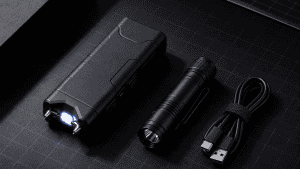
For multi-function carry, the MultiGuard and Streetwise Bouncer lines combine stun capability with personal alarm and LED flashlight in a single unit. For women who want one device that covers multiple self-defense scenarios, these integrated units reduce what you have to carry and think about in a high-stress moment.
Voltage is a starting point, not a finish line. The features that determine whether a stun gun actually protects you in the field are grip, safety system, rechargeability, and size-to-output ratio.
Grip matters more than most buyers anticipate. A device that slips or is difficult to orient under stress is a device that may not fire correctly when you need it. Look for rubberized or textured surfaces and a shape that fits naturally in your hand — not just on a product page, but in your actual grip. If you can hold the unit at a self-defense event or shop, do it.
Safety systems on quality stun guns operate on a sliding or rotating switch that requires deliberate engagement before the trigger activates. This prevents accidental discharge in a pocket or bag, which is both a liability issue and a battery drain concern. The disable pin wrist strap adds a second layer: if the device is taken from you, the pin pulls and the unit deactivates.
Rechargeability is a practical necessity. Disposable-battery stun guns require you to track battery life and carry replacements. Built-in rechargeable units — charged via USB or direct plug — eliminate that variable. Our post on how long rechargeable stun guns actually stay charged walks through real-world battery performance if you want the field-tested data on this question.
Size-to-output ratio tells you how much power you are carrying per inch of device. Advances in capacitor technology have made it possible to pack 20–50 million volts into a unit small enough to palm. There is no longer a meaningful tradeoff between portability and power at the high end of the market.
This is the honest question that matters most. Stun guns are effective non-lethal tools with a documented track record of stopping and deterring attacks — but no self-defense tool is a guarantee. Effectiveness depends on contact quality, attacker physiology, presence of thick clothing, and the user’s ability to deploy the device under stress.
Contact stun guns require you to be within arm’s reach of a threat. If you are not comfortable with that proximity or if your threat assessment scenario involves distance, a TASER or a pepper spray with a 12–18 foot range may be a better primary tool. Stun guns excel as close-range deterrents and backup options, and many women carry both a stun gun and a canister of WildFire or Pepper Shot spray to cover both distance ranges.
The deterrent value of a stun gun — the visible arc, the audible crack, the unmistakable warning of what the device is — should not be underestimated. Many confrontations end before a device is ever used. A stun gun you can activate visibly and audibly in a parking lot or stairwell communicates a clear message: this person is prepared, and escalating this encounter will have consequences.
For women who spend time in high-traffic environments or work late hours, a stun gun paired with a personal alarm covers the two most common deterrence scenarios: a loud alarm draws attention before a threat escalates; a stun gun provides close-range protection if it does. For environment-specific guidance, our stun guns for college campus and stun gun for bartenders pages address specific carry scenarios in detail.
The right stun gun is the one you will actually carry consistently, can deploy without hesitation, and are legally permitted to own in your jurisdiction. That sounds simple — and it mostly is, once you filter out the marketing noise.
Start with your carry context. If you commute on foot through urban environments, a compact high-voltage unit with a wrist strap like the Runt is purpose-built for that scenario. If you work in a bar, club, or late-night hospitality environment, a Streetwise Bouncer with an integrated alarm and flashlight gives you tools for multiple situations in one device. If you want maximum range and are willing to carry a larger unit, TASER is the clear choice.
Next, match output to your realistic deployment scenario. A 20-million-volt compact unit is more than sufficient for most close-range personal protection situations. Scaling up to 80 or 100 million volts provides a larger safety margin but not an exponential improvement in real-world effectiveness. Choose the output level that gives you confidence, not the highest number on the spec sheet.
Finally, handle the device before you rely on it. Activate the safety, grip it, and run through the motions of drawing it from your carry position — purse, pocket, holster. Familiarity with the mechanics of your device is the difference between confident deployment and fumbling under pressure. This is a skill that takes minutes to build and pays dividends in the moments that count.
For a broader look at how stun guns fit into a complete personal protection plan, the everyday self-defense tools for women guide covers the full toolkit with the same honest, practical framing.
In most U.S. states, women can legally own stun guns rated up to 100 million volts without a permit. TASER devices represent the top of civilian performance capability, offering neuromuscular incapacitation from up to 15 feet. Compact high-voltage units from Streetwise and the Runt and Spike product lines deliver 20–80 million volts in carry-ready form factors. Check your state and local laws before purchasing — legality varies by jurisdiction.
Yes. A well-engineered 20-million-volt stun gun delivers sufficient voltage and amperage to cause involuntary muscle contraction and neuromuscular disruption in an attacker. Output above 20 million volts provides an increased safety margin and can penetrate thicker clothing more reliably, but 20 million volts is widely considered a functional floor for real-world self-defense applications when amperage and pulse quality are properly optimized.
This is a legitimate concern, which is why the disable pin wrist strap is a critical safety feature. Units equipped with this system — including the Runt stun gun — deactivate automatically if the device is pulled from your grip, removing the weapon from the attacker’s usable arsenal. When selecting a stun gun, prioritize models with this feature, particularly if you carry in environments with close physical contact risk.
Quality stun guns use a sliding or rotating safety switch that must be deliberately engaged before the trigger can activate. This prevents accidental discharge in a pocket, purse, or bag. Additionally, units with a disable pin wrist strap add a second layer of security. Always verify the safety is engaged before holstering or stowing the device, and keep it in a dedicated compartment rather than loose among other items.
A traditional stun gun is a contact device — it must physically touch an attacker to deliver its charge, requiring you to be within arm’s reach. A TASER is a projectile device that deploys two probes via compressed nitrogen, delivering neuromuscular incapacitation from distances up to 15 feet depending on the model. TASER units are significantly more expensive but offer a meaningful tactical advantage in standoff distance. Both are legal in most U.S. states for civilian ownership.
Yes, with limitations. Standard stun guns penetrate light to medium clothing effectively. Heavy winter coats, thick leather, and layered insulation can reduce effectiveness by absorbing or dispersing the charge before it reaches muscle tissue. Higher-voltage units — 50 million volts and above — penetrate thick clothing more reliably. If your threat scenario involves cold-weather environments where attackers may be heavily clothed, factor output level and electrode spacing into your selection.
Recharge intervals depend on usage and storage conditions. A fully charged rechargeable stun gun holds a usable charge for several months under normal storage conditions without firing. Frequent test fires will deplete the battery faster. Most manufacturers recommend a monthly top-off charge to maintain peak readiness. If you use your device’s flashlight function regularly, recharge more frequently. For detailed field-tested data on charge retention, see our post on how long rechargeable stun guns actually stay charged.
Yes. Several product lines are specifically engineered for smaller hand profiles. The Runt stun gun at 3.5 inches and comparable compact units from the Spike and Shorty lines are designed to be palmed securely without requiring a wide grip span. Look for rubberized, textured surfaces and contoured designs that align the trigger naturally with your index finger. A device that fits your hand correctly is one you can deploy quickly and accurately under stress.






We use cookies to improve your experience on our site. By using our site, you consent to cookies.
Manage your cookie preferences below:
Essential cookies enable basic functions and are necessary for the proper function of the website.
These cookies are needed for adding comments on this website.
Statistics cookies collect information anonymously. This information helps us understand how visitors use our website.
Google Analytics is a powerful tool that tracks and analyzes website traffic for informed marketing decisions.
Service URL: business.safety.google (opens in a new window)