
U.S. Legal in Most States • Discreet Shipping • Real-World Protection • No Permits Required in Most Areas
U.S. Legal in Most States • Discreet Shipping • Real-World Protection • No Permits Required in Most Areas
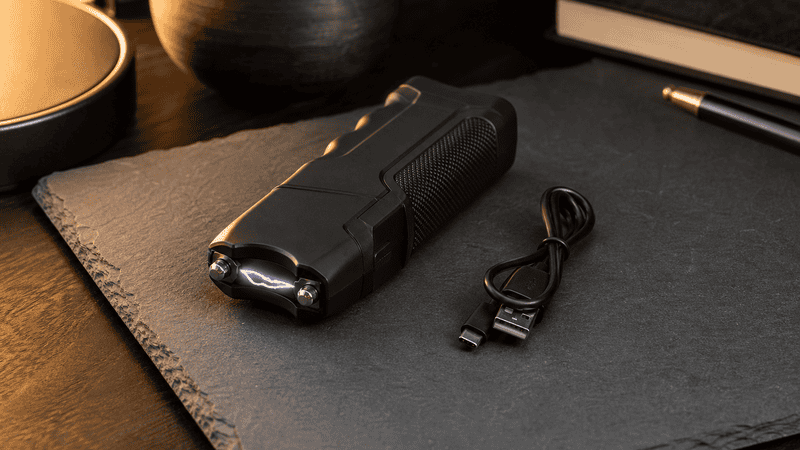
A quality rechargeable stun gun, properly maintained, holds a full operational charge for 30 to 90 days between charges — with high-grade lithium-ion units from established manufacturers reaching the upper end of that range under normal standby conditions. Discharge rate depends on battery chemistry, unit construction, ambient temperature, and whether the integrated flashlight or other features draw passive current. Budget units with inferior battery cells often fall below 30 days. This is one of the clearest performance differentials between entry-level and purpose-built stun guns.
That number matters more than most buyers realize. A stun gun sitting in a bag, a nightstand drawer, or a jacket pocket is drawing down its charge every single day — whether you fire it or not. When the moment arrives that it needs to perform, there is no margin for guesswork. The difference between a unit that retains charge reliably and one that degrades in weeks is the difference between a tool you can trust and a piece of equipment that only looks like protection. Serious self-defense practitioners understand this distinction. The battery chemistry, charge cycle count, and construction quality of your stun gun are not minor specifications. They are operational criteria.
Battery type is the single most significant variable. Lithium-ion cells — used in premium stun gun models — offer a self-discharge rate of approximately 1.5 to 2 percent per month under standby conditions. Nickel-metal hydride (NiMH) cells, found in lower-cost units, discharge at 20 to 30 percent per month. The performance gap is not incremental — it is categorical. A stun gun built on quality lithium-ion cells can sit in a drawer for two months and retain over 95 percent of its charge. The equivalent NiMH unit may be functionally depleted in the same period.
Beyond chemistry, build quality determines how efficiently a stun gun manages parasitic draw — the low-level current consumption that occurs even when the unit is powered off. High-quality electronics with proper power management circuits minimize this drain. Inferior designs allow the battery to bleed continuously through poorly isolated components. Units with integrated LED flashlights, indicator lights, or digital displays that run continuously present an additional drain factor that must be accounted for in any real-world charge assessment.
Ambient temperature also matters. Lithium-ion cells perform optimally between 59°F and 77°F. Storing a stun gun in a car during summer heat — regularly exceeding 130°F in parked vehicles — accelerates chemical degradation and permanently reduces capacity over time. Cold environments below freezing reduce discharge efficiency but typically do not cause lasting damage with quality cells. Temperature management is a discipline, not an afterthought, for anyone who treats their self-defense tools with appropriate seriousness.
Quality lithium-ion stun gun batteries are rated for 300 to 500 full charge cycles before measurable capacity loss occurs. At a monthly charging schedule — the standard recommendation for maintained-readiness units — that translates to 25 to 40 years of useful battery life under ideal conditions. In practical terms, battery degradation is not a limiting factor for serious users who maintain a consistent charging routine. The stun gun’s mechanical and electronic components will exceed their service life long before a quality lithium-ion cell becomes operationally insufficient.
NiMH cells, by contrast, are typically rated for 200 to 300 cycles and suffer from a phenomenon called memory effect — if partially discharged cells are recharged before full depletion, they gradually “remember” the shorter discharge cycle and deliver reduced capacity. This is why budget units often seem to work initially but develop charge problems within the first year of ownership. The failure is not random. It is a predictable consequence of inferior battery chemistry combined with inconsistent charging habits. Practitioners who demand performance over time invest in units designed to deliver it.
The industry-standard recommendation for lithium-ion stun guns held in a readiness posture is a full charge cycle every 30 days. This interval maintains the battery above 97 percent of rated capacity and does not stress the cell through unnecessary charge cycles. For units with integrated flashlights that see regular use, a two-week recharge cycle is more appropriate, since LED runtime draws down capacity at a rate that varies by lumen output and duration of use.
For units that see daily carry — particularly stun guns carried during walks or outdoor activity — testing the unit’s discharge at the 30-day mark during initial ownership is a sound practice. Fire a one-second test arc into open air and assess arc intensity. A quality unit will deliver full output arc with no visible degradation. If arc strength has measurably diminished, your use pattern demands a shorter recharge interval. Field-testing your specific unit under your specific conditions is the only way to calibrate precisely.
One discipline worth adopting: charge your stun gun on a fixed calendar date — the first of each month works well — regardless of estimated remaining capacity. Inconsistent “charge when I remember” habits are how readiness gaps develop. A device that failed its user because of a depleted battery wasn’t a bad product. It was a good product managed poorly. The distinction matters.
Mechanical activation is the primary risk in carried storage, not passive discharge. Most quality stun guns include a physical safety switch or disabling pin specifically to prevent accidental discharge during carry — and accidental discharge is a significant battery drain event. A full one-second arc at rated voltage consumes a meaningful fraction of total charge capacity. Several inadvertent activations across a month can cumulatively drain a unit that a user believes is at full charge.
For women who carry stun guns in a bag or purse, this is a particularly important operational consideration. Purpose-built models like those in the Streetwise and Runt lineups incorporate recessed activation controls and positive-engagement safety switches designed specifically to prevent unintended carry discharge. The best stun guns designed for women’s carry treat accidental activation prevention as a core design requirement, not an optional feature. If your current unit has an exposed trigger and a safety that can be nudged off in a bag, that is not a prestige-tier product.
Arc intensity is the most direct field indicator of battery condition. A fully charged quality unit produces a bright, stable, high-frequency arc. Diminishing arc brightness, sputtering, or arcs that terminate prematurely suggest the battery is delivering below its rated voltage output — either because it is partially discharged or because cell capacity has degraded. This is not a subtle distinction to the trained eye.
A second indicator is charge time. Most stun gun batteries reach full charge in two to four hours from a depleted state using the provided charger. If a unit that previously required three hours now reaches manufacturer’s indicated full charge in under 90 minutes, the battery is not charging faster — it has lost capacity and is filling a smaller reservoir. Conversely, a unit that no longer holds a charge indicator stable after disconnection from the charger is showing early signs of cell failure. Neither condition is acceptable in a serious self-defense tool.
If your stun gun is more than five years old, a battery performance assessment is warranted regardless of visible condition. For security professionals and others in high-demand stun gun applications, a defined equipment refresh cycle — not based on failure, but on service life — is the standard of operational discipline that separates professional deployments from casual ownership.
Yes — and the specification to prioritize is battery capacity expressed in milliamp-hours (mAh). Higher mAh ratings, combined with low parasitic draw circuitry and quality lithium-ion cells, produce the longest standby performance. Units in the Streetwise lineup, for example, are consistently engineered with high-capacity cells and low standby drain — a combination that supports 60 to 90 days of standby readiness at full charge for their flagship models.
The TASER Pulse 2 represents the upper tier of consumer-grade rechargeable stun technology, incorporating advanced power management and a sealed lithium battery that maintains charge integrity exceptionally well between use cycles. For users who prioritize standby duration as a primary criterion — including those with stun guns positioned for home defense that may go weeks without being handled — selecting on battery specifications rather than price point is the correct analytical framework.
For runners and high-activity users, where the unit is handled and potentially test-fired regularly, charge retention under active use conditions matters more than raw standby duration. The best stun guns for runners balance compact form factor with sufficient battery capacity to sustain regular use cycles between charges. Understanding which use profile you’re optimizing for is the starting point for making a genuinely informed selection.
If you want to understand what separates quality stun gun construction from the rest of the market at a foundational level, this breakdown of quality indicators and red flags covers the full picture — battery specifications included.
Quality lithium-ion stun guns retain charge for 30 to 90 days under standby conditions, with self-discharge rates of approximately 1.5 to 2 percent per month. Budget units using NiMH cells discharge 20 to 30 percent monthly. For operational readiness, a monthly charge cycle is the standard maintenance interval for lithium-ion units.
Most modern stun guns with lithium-ion batteries include overcharge protection circuitry that stops current flow when the cell reaches full capacity. However, extended charging beyond the manufacturer’s recommended period — typically two to four hours — can cause heat buildup that gradually degrades cell chemistry. Follow the stated charging window and disconnect on schedule.
Key indicators include diminished arc intensity at full charge, charge cycle completion significantly faster than normal (suggesting reduced cell capacity), and failure to maintain a stable charge indicator after disconnection. Any of these conditions in a unit over three to five years old warrants battery evaluation and possible unit replacement.
Yes. Integrated LED flashlights are the primary active drain source on stun gun batteries. A 100-lumen flashlight running for one hour consumes measurably more capacity than several weeks of passive standby draw. Users who rely on their stun gun’s flashlight regularly should maintain a two-week recharge interval rather than the standard monthly schedule.
For lithium-ion batteries, no. Full discharge before recharging — called deep cycling — stresses lithium-ion cells and accelerates degradation. These batteries perform best when maintained between 20 and 80 percent charge under regular use. Full charge cycles as recommended by the manufacturer, without intentional deep discharge, maximize battery service life.
High heat is the primary threat. Storing a stun gun in a parked vehicle during summer — where interior temperatures routinely exceed 130°F — permanently degrades lithium-ion cell chemistry over time. Optimal storage is 59°F to 77°F. Cold temperatures reduce short-term discharge efficiency but cause less lasting damage to quality lithium-ion cells than sustained heat exposure.
Higher-voltage output per discharge means each activation consumes more battery capacity than a lower-powered equivalent. However, standby drain — the passive daily discharge — is largely independent of rated voltage. For users who test-fire their unit regularly, a higher-capacity battery is advisable. Infrequent activators will see minimal real-world difference in standby duration relative to output rating.
Most rechargeable stun guns reach full charge in two to four hours from full depletion using the supplied charger. Fast-charging from aftermarket sources is not recommended — the elevated current can cause heat damage to battery cells not rated for high-current input. If recharge time has shortened significantly from original baseline, battery capacity loss is the likely cause, not improved charging efficiency.
A stun gun that cannot be trusted to be charged when needed is not a self-defense tool — it is a liability. The distinction between units that maintain their performance across months of real-world use and those that degrade within weeks is not marketing. It is engineering, materials, and quality control — the same criteria that separate any precision instrument from its generic equivalent. Monthly charging discipline, proper storage, and selection of a unit built on quality battery chemistry are the three variables entirely within your control. The rest is product quality. Choose accordingly.
Browse the full selection at Nittany Self Defense and filter by the specifications that matter: battery type, charge cycle rating, and standby duration — because the details that most buyers overlook are exactly the ones that determine whether your stun gun performs when it counts.







We use cookies to improve your experience on our site. By using our site, you consent to cookies.
Manage your cookie preferences below:
Essential cookies enable basic functions and are necessary for the proper function of the website.
These cookies are needed for adding comments on this website.
Statistics cookies collect information anonymously. This information helps us understand how visitors use our website.
Google Analytics is a powerful tool that tracks and analyzes website traffic for informed marketing decisions.
Service URL: business.safety.google (opens in a new window)