
U.S. Legal in Most States • Discreet Shipping • Real-World Protection • No Permits Required in Most Areas
U.S. Legal in Most States • Discreet Shipping • Real-World Protection • No Permits Required in Most Areas

For real estate agents who show homes solo, the most effective pepper spray format isn’t the one with the highest Scoville rating or the largest canister — it’s the one that’s accessible within two seconds, deployable in an enclosed space without causing self-contamination, and carried consistently because it fits naturally into a professional routine. Gel formulas in belt-clip or keychain formats are the most practical choices for this profession.
Most self-defense guides treat pepper spray as a generic problem with a generic solution. Hand someone a canister and call it done. But the real estate agent’s threat environment is different in ways that most guides never address — and those differences change everything about what you should carry. There’s a specific combination of factors at work here that most agents never consider until something goes wrong.
Understanding those factors is the gap between carrying something and carrying something that actually works.
The answer isn’t just “strangers in empty houses,” though that’s the core of it. The real estate showing environment creates a specific convergence of vulnerabilities that few other professions share simultaneously. You are alone with an unknown individual. You are in an enclosed space with limited exits. You have often advertised your location publicly — the sign in the yard, the listing with the address, the appointment that anyone could book under a false name.
That last element is what separates this threat profile from, say, a convenience store worker who also deals with unknown individuals but operates in a public space with surveillance, other employees, and customers present. In a vacant property, none of those environmental safety factors exist. You are the only resource in the building.
The enclosed space factor directly affects which spray formats work and which ones don’t. A standard aerosol stream or fogger that works perfectly in an outdoor or large-space scenario becomes a liability in a small bathroom, a finished basement, or a tight hallway. The agent needs a format specifically engineered for confined deployment — and that requirement alone eliminates a significant portion of products on the market.
Gel-based formulas are the professional’s choice for indoor deployment. Unlike aerosol fog or cone sprays, gel attaches on contact and does not become airborne as a particulate cloud. This distinction is critical. In a 10-by-12-foot room, a fogger or heavy stream spray can contaminate the air rapidly, affecting your own eyes and respiratory system before you can exit. Gel lands where you aim it, reduces blowback risk in still indoor air, and is significantly harder for an attacker to wipe away quickly.
Stream formulas occupy a middle ground — more precise than fog, less airborne than a cone spray, but still producing some mist in completely still air. In outdoor conditions or large interior spaces, streams perform well. In tight interior spaces, gel is the more reliable choice.
Foam formulas offer similar confinement-friendly characteristics to gel but with slightly less range. In most showing scenarios, the range tradeoff is acceptable — but it’s worth knowing that gel typically delivers 10 to 15 feet of effective range, while foam may reduce that to 6 to 10 feet depending on the unit.
What definitively doesn’t work: large fogger or cone-spray units designed for crowd control or wide-area deterrence. Bear spray, riot-style canisters, and wide-dispersal defense sprays are outdoor tools. Deploying them indoors is as likely to incapacitate the user as the threat.
Accessibility is the variable most agents underestimate. A canister at the bottom of a briefcase or buried in a purse might as well not exist. In a high-stress situation, fine motor control degrades, cognitive load spikes, and the search time required to locate a buried item can be measured in critical seconds you do not have.
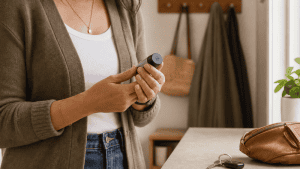
The carry method that produces the fastest deployment is a dedicated belt-clip pepper spray worn at the hip. This keeps the unit in a fixed, consistent location that muscle memory can locate without visual confirmation. Agents who prefer not to clip gear to a belt should consider keychain-format units that remain attached to the hand whenever keys are held — which, conveniently, is exactly when you’re unlocking a property.
The keychain format has one specific tactical advantage for real estate scenarios: you’re already holding your keys when you enter a property. A keychain canister requires no additional retrieval step. The unit is in your hand. That detail matters more than it might initially seem.
Pocket carry is acceptable with practice. The critical requirement is that the canister must be in a dedicated pocket — not shared with a phone, pen, or anything else that creates retrieval friction. The same pocket, every time. In every showing.
Major Capsaicinoids (MC) percentage is the metric that actually measures stopping effectiveness — not Scoville Heat Units (SHU), which measures raw pepper heat but doesn’t directly translate to incapacitation performance. Look for a product with a minimum 1.0% MC rating. Premium formulations reach 1.33% MC or higher.
Oleoresin Capsicum (OC) concentration listed on a canister — typically 2%, 5%, 10%, or higher — indicates the percentage of pepper extract in the formula, but because pepper plants vary in natural potency, OC percentage alone doesn’t guarantee incapacitation strength. This is a detail most buyers never learn, which is part of why some agents end up carrying products that underperform when it matters.
Formulations like Defense Technology pepper spray are used by law enforcement and correctional facilities precisely because they meet verified MC standards rather than relying on marketing-friendly SHU numbers. That’s the benchmark worth applying when selecting a product for professional use.
WildFire and Streetwise are two additional brands available through serious self-defense retailers that specify MC concentration clearly. When a product’s label emphasizes SHU without stating MC percentage, treat that as an incomplete specification — and an incomplete specification is a risk you don’t need to carry into a vacant property.
Several. The first: your arrival sequence matters more than your carry position. Arriving early, doing a walkthrough alone before the prospect arrives, and establishing your exit awareness before anyone else enters the building gives you information that is difficult to recover once a showing is underway. Most agents skip this step. The ones who’ve had close calls rarely skip it twice.
The second tactic is physical positioning. During a showing, keep the prospect in front of you. Move them through the home — let them lead room to room while you maintain a position between them and the exit. This is standard training used by agents who take solo-showing safety seriously, and it costs nothing to implement.
The third: combine tools. Pepper spray addresses a contact-range or short-range threat scenario. A personal alarm addresses the need to attract attention before a situation escalates to contact. Carrying both is not redundant — they solve different problems in the threat timeline. A 130dB personal alarm creates noise that draws attention and can interrupt aggressive intent before physical confrontation begins. Pepper spray is the response when interruption has failed.
Finally, understanding the legal framework in your state before carrying is not optional. Pepper spray laws vary by state in ways that affect canister size limits, formulation restrictions, and carry conditions. Knowing the rules for your jurisdiction is baseline professional knowledge.
Based on the threat environment and carry constraints specific to this profession, the optimal loadout is straightforward: a gel-formula pepper spray unit in a keychain or belt-clip format, rated at 1.0% MC or higher, with a safety mechanism that prevents accidental discharge in a bag or pocket but deploys quickly under deliberate activation pressure.
Mace, WildFire, and Streetwise all offer gel-formula options with verified performance specifications. Pepper Shot and Defense Technology rounds out the list of brands that publish MC data rather than hiding behind SHU marketing.
Canister size for this application should be compact — 0.5 oz to 1.0 oz is sufficient for a showing scenario. Larger units carry more volume but add bulk that reduces the likelihood of consistent carry. A product that stays in the car because it’s inconvenient to carry provides exactly zero protection inside a property.
For agents who want to explore the full range of carry-ready options, buying pepper spray online from a dedicated self-defense retailer gives access to specification-complete product listings that consumer retail shelves typically don’t provide.
For enclosed spaces like vacant homes, gel is the superior format. Gel attaches on contact and does not disperse as an airborne particulate, which means it reduces blowback contamination in still indoor air. Stream spray performs well in outdoor or large-space scenarios but introduces self-contamination risk in tight rooms and hallways. For real estate showing environments specifically, gel is the professional-grade choice.
Most keychain-format pepper spray units deliver an effective range of 6 to 10 feet, depending on the formula type and nozzle design. Gel formulas typically reach 8 to 12 feet. Stream formulas from compact units can reach 10 to 12 feet. For interior showing environments, these ranges are generally sufficient — most threat scenarios in vacant homes occur at conversational distance or closer.
Pepper spray is legal to carry in all 50 states, but individual state laws regulate canister size, OC concentration limits, and in some cases the buyer’s age or criminal history. Some jurisdictions restrict canister volume to 4 oz or less; others have specific formulation limits. Check your state’s current statutes before purchasing. Professional carry status does not create exceptions to these regulations in most jurisdictions.
Most manufacturers specify a 2 to 4 year shelf life, with some professional-grade formulas rated to 4 years. Propellant pressure degrades over time, which reduces range and spray pattern performance even if the canister has never been discharged. Check the expiration date stamped on the canister. A unit that has expired — or is close to expiration — should be replaced, not carried as a primary defense tool.
There is no legal requirement to disclose that you are carrying a legal self-defense tool. Disclosure is a personal and professional judgment call. Some agents prefer transparency; others prefer that their preparedness remain unannounced. The more important factor is consistent, practiced carry — not whether you’ve announced it. The purpose of carrying is readiness, not deterrence through visibility.
OC percentage indicates how much oleoresin capsicum extract is in the formula by volume. Major Capsaicinoids (MC) percentage measures the actual active incapacitating compounds within that extract. Because pepper plants vary in natural potency, a 10% OC spray from weak-potency peppers may contain fewer active capsaicinoids than a 2% OC spray from high-potency peppers. MC percentage is the more reliable performance metric — look for 1.0% MC minimum.
For most showing scenarios, a single properly-selected canister is sufficient. A standard 0.5 oz to 1.0 oz unit contains enough formula for multiple deployments. The more meaningful variable is not volume but accessibility — one properly carried unit in a fixed location is more effective than two units that require a search to locate. If you carry a backup, keep it in a different but equally consistent location.
Pepper spray use is governed by self-defense law in your jurisdiction — specifically the standard of reasonable force in response to a reasonably perceived threat. Using it against an actual threat in a legitimate self-defense scenario is generally legally defensible. Using it in circumstances that don’t meet that threshold creates legal exposure. This is not legal advice — consult with a licensed attorney familiar with your state’s self-defense statutes if you have specific questions about liability.
The agents who never think about this topic are banking on the assumption that nothing will happen. That assumption has worked for most of them — so far. The ones who’ve had a close call in a vacant property understand something the others don’t: the showing environment is a specific threat context that requires a specific preparation. What you carry matters. How you carry it matters more. And carrying something designed for a different environment entirely — a fogger in a small bathroom, a buried canister in a packed bag — is barely better than carrying nothing.
The right combination of format, formulation, and carry method is not complicated. But it does require knowing what questions to ask. Browse the full selection of professional-grade pepper spray options at Nittany Self Defense and pay attention to the specifications that actually predict performance — MC percentage, formula type, and canister size. The details that most buyers overlook are exactly the ones that determine whether a product works when it needs to.




We use cookies to improve your experience on our site. By using our site, you consent to cookies.
Manage your cookie preferences below:
Essential cookies enable basic functions and are necessary for the proper function of the website.
These cookies are needed for adding comments on this website.
Statistics cookies collect information anonymously. This information helps us understand how visitors use our website.
Google Analytics is a powerful tool that tracks and analyzes website traffic for informed marketing decisions.
Service URL: business.safety.google (opens in a new window)