

U.S. Legal in Most States • Discreet Shipping • Real-World Protection • No Permits Required in Most Areas
U.S. Legal in Most States • Discreet Shipping • Real-World Protection • No Permits Required in Most Areas
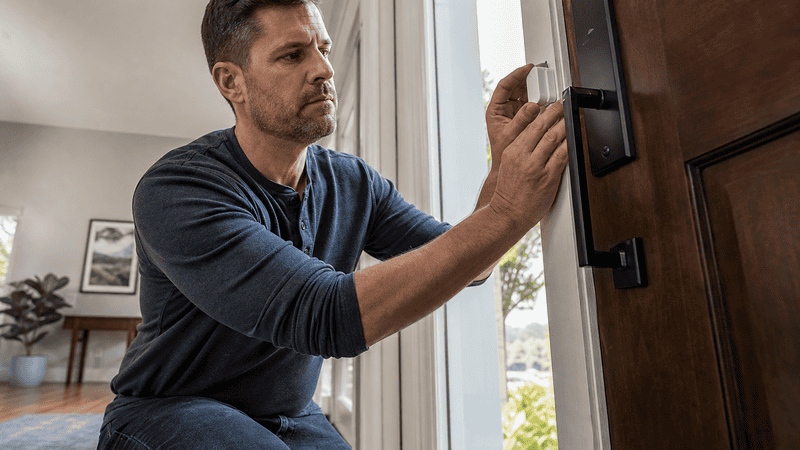
Layered home security means deploying multiple, independent detection points so that no single failure — a missed lock, an unmonitored window, a door left cracked — hands an intruder a free pass into your home. Door and window alarms are the backbone of that layered approach: low-cost, installation-free entry-point sensors that trigger 100–130dB alerts the moment a contact is broken, buying you critical seconds to respond before a threat reaches your family.
Most homeowners treat security as a single line of defense — a deadbolt, maybe a porch light, and the assumption that’s enough. It isn’t. Professional security assessments consistently identify windows and secondary doors as the preferred entry points for residential break-ins, precisely because homeowners over-invest in front door hardware and ignore everything else. A layered strategy closes that gap. You don’t leave it to chance. You build overlapping detection zones so that no matter how an intruder attempts entry, they trigger an alarm before they’re inside.
A single alarm is a single point of failure. One dead battery, one sensor misaligned, one window you forgot to arm — and your perimeter is open. Layered security operates on redundancy: each detection device covers a specific entry point independently, so the failure of any one unit doesn’t compromise the system. This is the same principle professional security firms apply to commercial installations, and it translates directly to residential use.
Door and window alarms add active, audible deterrence at the point of breach — the moment a contact is broken, the alarm fires. This is distinct from perimeter cameras, which observe but don’t deter, and from smart home hubs, which require connectivity and power to function. Magnetic contact alarms have no network dependency. A 120dB alert triggered at 2:00 AM needs no Wi-Fi signal and no monitoring subscription to be effective. That independence is a tactical advantage, not a limitation.
The data supports layered approaches. Studies on residential burglary consistently show that audible alarms — even simple, self-contained contact alarms — significantly increase the probability that an intruder abandons the attempt. Speed of entry is everything to a burglar; anything that slows them down or draws attention eliminates the risk-reward calculation that made your home a target in the first place.
Priority one: every ground-floor entry point. Front door, back door, side door, garage access door. These are the highest-traffic entries and the highest-risk breach points. Install magnetic contact alarms on all of them before you address anything else. A 125dB door alarm on a rear entry that isn’t visible from the street is not optional — that’s exactly where an intruder will probe first.
Priority two: ground-floor windows, particularly those with limited sightlines from the street or neighboring properties. Sliding glass doors, basement windows, and windows adjacent to landscaping that provides concealment are all high-value targets. Sliding window alarms with vibration-sensing capability add an additional detection layer — they trigger on glass movement or impact before a window is fully opened, which gives you earlier warning than a standard contact break.
Priority three: second-floor access points near flat roofs, attached garages, or large trees. Professional threat assessment routinely identifies these as overlooked vulnerabilities. A window alarm costs under $15 and installs in under two minutes. There is no justification for leaving any accessible window unprotected once you’ve addressed the ground floor.
If you’re protecting a rental or apartment where you cannot modify hardware, door and window alarms built specifically for renters use adhesive mounting with no permanent installation required — full coverage without violating your lease.
A door stop alarm is one of the most underutilized tools in residential security. It does double duty: it physically impedes door movement by wedging against the floor, and it triggers a piercing 120dB alarm if pressure is applied to the door. Unlike a standard contact alarm mounted on the door frame, a door stop alarm requires no installation at all — place it, and it’s active.
The tactical application is straightforward. Use a door stop alarm with sensor on interior doors — bedroom doors in particular — as your second line of defense. If an intruder defeats your entry-point alarm and gets inside, the interior door alarm fires the moment they attempt to push through. This creates detection depth: an alarm at the perimeter and an alarm at the interior. Two independent triggers mean two opportunities to wake up, respond, and call for help before a threat reaches you.
Door stop alarms are also the correct tool for hotel rooms, Airbnb stays, and any temporary accommodation where you have zero control over who has key access. Pack one in your travel bag alongside your personal alarm. This is not overcaution — it’s tactical awareness applied consistently.
The threshold that matters is 110dB. Below that, you’re generating noise. At and above 110dB, you’re generating a physiological stress response — elevated heart rate, disorientation, and an overwhelming drive to exit the situation. Most quality door and window alarms operate in the 120–130dB range. At 120dB, the sound is physically painful at close range. At 130dB, you’re approaching the threshold of immediate hearing damage with sustained exposure.
For sleeping occupants, research on alarm audibility indicates that 75dB at the sleeper’s location is sufficient to achieve reliable awakening. A 120dB alarm mounted on a bedroom door or adjacent window will exceed that threshold in virtually any residential floor plan, even through closed interior doors. The alarm doesn’t have to be in the room — it has to be loud enough to penetrate your sleeping environment.
For households with heavy sleepers, elderly occupants, or individuals who may not respond immediately to sound, door and window alarms configured for dementia patients and alarms designed for sleepwalkers offer additional alert options, including remote chime receivers that can be placed in the primary bedroom for immediate notification regardless of where the triggered sensor is located.
Door and window alarms are the detection layer. Your response capability is a separate, equally important layer. When an alarm fires, you need immediate options. That means a personal alarm within reach of your bed — a 130dB unit you can activate in the dark, in seconds, without fumbling. It means knowing exactly where your defensive tools are and being able to access them without hesitation.
For homeowners who want to understand how home alarm systems fit into a broader security posture, the detailed breakdown of home alarm pros and cons on this site covers the full picture — including where simple contact alarms outperform complex monitored systems and where monitoring adds genuine value.
For households with children, the detection-response integration requires additional planning. Door and window alarms for kids and toddlers serve a dual purpose: they alert parents to unsupervised exits and add a perimeter security layer that doesn’t require children to understand or operate any system. The alarm does the work.
The final layer is interior lighting. A triggered alarm paired with automatic lights — either smart bulbs or simple motion-activated fixtures — denies an intruder the cover of darkness and simultaneously signals to neighbors and passersby that something is wrong. Visibility is deterrence. An intruder operating in a lit, alarmed environment has no tactical advantage. That’s the goal: remove every advantage before they’re inside.
The first and most critical mistake is incomplete coverage. Homeowners alarm their front door and leave every window and secondary door unprotected. An intruder doesn’t need your front door — they need any unalarmed entry point, and they will find it. Complete coverage means every accessible entry point is protected, not just the ones you use most often.
The second mistake is poor sensor placement. Magnetic contact alarms require the two components — the alarm body and the magnet — to be aligned within the manufacturer’s specified gap tolerance, typically 1/2 inch or less. Gaps larger than that will trigger false alarms or, worse, fail to trigger when the contact is broken. Follow placement specifications exactly, and test every sensor immediately after installation.
Third mistake: dead batteries. A door alarm with a dead battery is a decoration. Establish a quarterly battery replacement schedule and mark it in your calendar. Most modern door and window alarms use standard CR2 or AAA batteries with 6–12 month life under normal use — but don’t wait for the low-battery chirp to find out. Replace on schedule.
Fourth mistake: failing to test after installation and periodically thereafter. Every alarm should be triggered manually at least monthly to confirm the sensor is functioning, the battery is live, and the alarm volume hasn’t degraded. Testing is not optional — it’s the only way to know your system is operational when you need it.
Most single-family homes require 8–15 sensors to achieve full coverage: typically 3–5 exterior doors (including garage access) and 5–10 ground-floor windows. Two-story homes should add sensors to any second-floor windows accessible via flat roof, attached structure, or nearby trees. Start with ground-floor perimeter coverage, then expand inward and upward. Every accessible entry point without a sensor is a gap in your defense.
Yes. Magnetic contact alarms designed for sliding doors mount on the door frame and the sliding panel — when the panel moves, the contact breaks and the alarm triggers. For sliding windows, select alarms rated for horizontal sliding operation. Some models also include vibration sensors that trigger on impact before the contact is fully broken, giving you earlier warning on windows with lightweight frames or older hardware.
Yes. Most modern door and window alarms use 3M adhesive backing or double-sided foam tape that removes cleanly from painted surfaces and door frames without damage. Verify the adhesive type before installation, and test a small area on an inconspicuous surface first. Renters should also consider door stop alarms, which require zero mounting and are fully portable — take them when you move.
A door or window alarm triggers on contact break — the moment the entry point is opened. A motion sensor triggers on movement within a defined range inside the space. Door and window alarms provide perimeter detection before an intruder enters. Motion sensors detect intruders who are already inside. Layered security uses both: perimeter contact alarms as the first line, interior motion detection as the second. Neither replaces the other.
120dB is roughly equivalent to a live rock concert at close range or a chainsaw at arm’s length. It is loud enough to cause immediate disorientation, wake sleeping occupants in adjacent rooms, and be heard clearly by neighbors in typical residential settings. The vast majority of door and window alarms on the market operate between 110dB and 130dB — that range is both effective deterrence and reliable wake-up capability for most households.
Arm them continuously whenever your home is unoccupied, and at night while you sleep — which are also your highest-risk windows. Daytime burglaries account for a significant portion of residential break-ins; criminals actively target homes that appear empty. If your system uses a keypad or delay function, configure it to allow normal household traffic while maintaining 24/7 protection on unoccupied areas. Most contact alarms can be switched off individually in seconds for daily use without disarming your entire perimeter.
For standalone contact alarms — the battery-powered magnetic sensors that operate independently — the wireless vs. wired distinction doesn’t apply in the traditional sense. These units are self-contained: the alarm sounds locally at the sensor when contact is broken, with no wireless signal required. For integrated smart home alarm systems, the comparison between wireless and wired window alarm setups covers reliability differences, installation requirements, and which configuration makes sense for your specific situation.
Standard magnetic contact alarms only trigger on contact break — an open window or door. They will not trigger if glass is cut or broken without disturbing the sensor. For this threat profile, add glass break detectors, which respond to the specific acoustic frequency of breaking glass, or vibration-sensing window alarms that detect impact before a full break. Include both contact and vibration-sensing alarms in your window coverage for complete protection against multiple breach methods.
Your home security is only as strong as your weakest unprotected entry point. Every window you leave unmonitored, every secondary door without a sensor, every interior space that lacks a detection layer is an invitation — one that a determined intruder will accept. A complete layered approach with door and window alarms at every accessible entry point, door stop alarms on interior bedroom doors, and a clear response plan eliminates that invitation entirely. Browse the full selection of door and window alarm solutions at Nittany Self Defense and build coverage that leaves nothing to chance.







We use cookies to improve your experience on our site. By using our site, you consent to cookies.
Manage your cookie preferences below:
Essential cookies enable basic functions and are necessary for the proper function of the website.
These cookies are needed for adding comments on this website.
Statistics cookies collect information anonymously. This information helps us understand how visitors use our website.
Google Analytics is a powerful tool that tracks and analyzes website traffic for informed marketing decisions.
Service URL: business.safety.google (opens in a new window)